












On a facial ingredient list, ylang ylang almost never appears where people expect it. It is not near the top with the carrier oils. It is at the bottom, usually in the last two or three items, often just before or after the vitamin E — and that position is the most informative thing about it.
Written properly it reads Cananga odorata. It is one of the oldest commercial perfume materials in the world, it is distilled in a way almost no other floral oil is, and the word on the label does not tell you which of four quite different oils you are actually getting.
This is a label-reading guide. Nothing below describes what the oil does once it is on your face. It covers what the tree is, how the oil is separated into grades, why those grades are not interchangeable, and what its position on an ingredient list tells you.
What ylang ylang actually is

Cananga odorata is a fast-growing tropical tree in the custard-apple family, native to the Philippines, Indonesia and Malaysia and now grown commercially in Madagascar, the Comoros and Réunion. The name comes from a Tagalog root usually translated as "flower of flowers."
The flowers are the point. They hang in drooping clusters of narrow, ribbon-like petals, greenish when they open and turning deep yellow as they mature. They are picked by hand, early in the morning, and only once they have gone fully yellow — an unripe green flower yields a thin, comparatively characterless oil. The harvest is daily during season, and the flowers have to reach the still within hours.
A mature tree can produce flowers more or less year-round, which is unusual for a perfume crop and part of why the material stayed commercially viable for well over a century while other naturals were displaced by synthetics.
The four grades are the part nobody explains
Here is what makes ylang ylang genuinely different from almost every other botanical oil on a skincare label: it is not distilled once. It is distilled continuously, and the distillate is drawn off in successive fractions as the run proceeds. Each fraction is collected separately and sold as a different product.
- Extra — the first fraction, drawn off in roughly the first hour. Lightest, most intensely floral, most volatile. The perfumery grade, and the most expensive.
- First — the next fraction. Still floral, slightly heavier.
- Second — heavier again, less of the delicate top character.
- Third — the last fraction, taken from the tail of the run. Heaviest, woodiest, least floral, cheapest. Common in soaps and detergents where the fine top notes would be wasted anyway.
There is also "complete," which is either an uninterrupted distillation collected as a single batch, or the fractions recombined. It is not a grade so much as a description of how the run was handled.
The chemistry shifts across those fractions in a predictable direction. The early cuts are richer in the lighter, more volatile esters and ethers — linalool, benzyl acetate, methyl benzoate, para-cresyl methyl ether. The later cuts carry proportionally more of the heavier sesquiterpenes such as germacrene D and caryophyllene. Same flowers, same still, same day. Different oil.
An ingredient list that says only "ylang ylang essential oil" is telling you the species. It is not telling you the grade, and the grade is most of the difference in cost and character.
Why it sits at the end of the list
Cosmetic ingredient lists run in descending order of concentration down to 1%, after which the order is at the formulator's discretion. Essential oils used for aroma live in that tail. Ylang ylang is a potent aromatic material — it is used at fractions of a percent, and using more is not better. It is loud.
So when you see it as the last item, that is not an afterthought. That is the oil being used at the level it is meant to be used at. An aromatic material appearing high on a facial list would be the thing worth questioning.
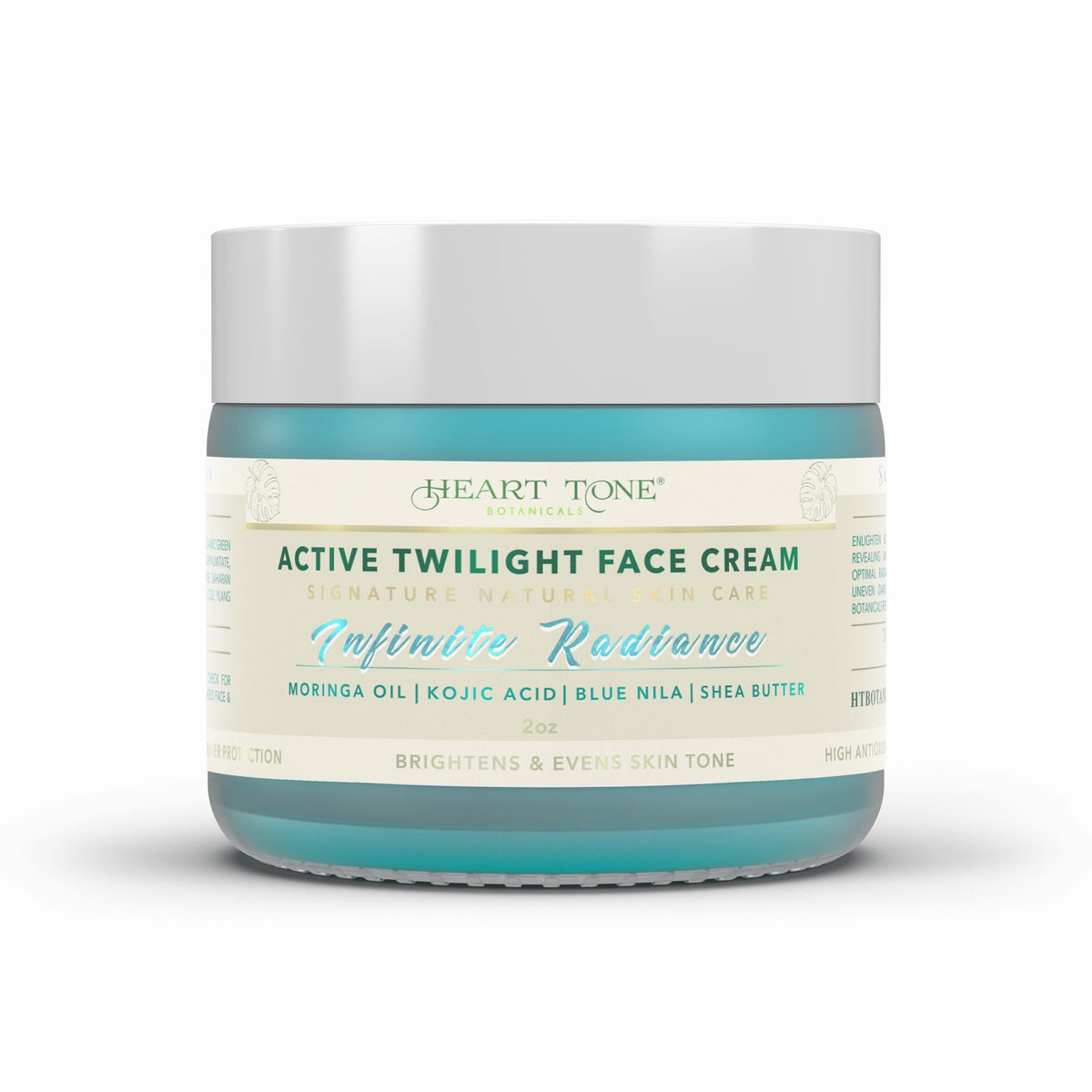
On our own two facial products it lands exactly there. The Complete Daily Face Moisturizer runs to twenty-two ingredients, and the first thirteen are pressed seed oils — moringa, jojoba, abyssinian, apricot, green tea, raspberry, noni seed, pomegranate seed, black seed, sea buckthorn, blueberry, rosehip and prickly pear. Then carrot CO2, bakuchiol and vitamin E. The aromatics come last, in a cluster: blue chamomile, ylang ylang, geranium, blue tansy and green coffee, with CoQ10 closing the list. Ylang is the eighteenth of twenty-two.
The Active Twilight Face Cream is a much shorter list — shea butter, moringa, green tea and castor oils, kojic acid dipalmitate, licorice root, Saharan blue nila, vitamin E, coriander seed CO2 — and ylang ylang is the last ingredient on it, full stop.
It is worth saying what is not true, because "botanical brand" is often assumed to mean "ylang in everything." It is not in our Island Mist hydrosol, and it is not in the Dynamic Hydrogel Face Serum. Two products out of the facial range carry it. That is the whole list.
If you are fragrance-cautious
This is the practical reason to know the name. Ylang ylang is a naturally occurring aromatic, and several of its components — linalool and benzyl benzoate among them — are on the EU's list of fragrance substances that must be declared individually when they exceed set thresholds in a leave-on product. You will sometimes see those component names printed after the essential oils on a European label. That is not a contaminant list. It is a disclosure requirement.
"Fragrance-free" and "no synthetic fragrance" are not the same statement, and a product scented entirely with essential oils is still a scented product. If you avoid fragrance, ylang ylang counts, and it is one of the more assertive florals to avoid. We wrote about how that single label word works in fragrance in skincare.
How to recognise it on a label
Names you may encounter, all referring to the same tree:
- Cananga odorata flower oil — the standard INCI form
- Ylang ylang oil — the common trade name, sometimes hyphenated or written as one word
- Cananga oil — usually a related variety (Cananga odorata var. macrophylla), distilled in one pass without fractioning, mostly from Java. Similar family, coarser character, cheaper
- Extra / I / II / III / complete — the fraction, when a brand bothers to state it
Two flags worth noticing. If a list says "ylang ylang fragrance" or "ylang ylang parfum," that is a scent compound built to smell like ylang, not the distilled oil. And a genuinely cheap product claiming a top-grade floral is worth a second look — extra-grade ylang is expensive because the first hour of a distillation run is a small fraction of the total yield.
Storing it
Ylang ylang is more stable than the polyunsaturated seed oils it is usually blended into — the aromatic molecules that make up the bulk of it are not the ones that go rancid. The lighter top-note components do fade with air and heat, so a finished product that smells noticeably flatter than it did is losing its top notes before anything else is happening. Cool, dark, closed. The same handling that suits a pressed seed oil suits the finished blend.
The short version
Ylang ylang is the fractionally distilled flower oil of a tropical tree, sold in four grades that are chemically different from each other, used at well under one percent, and found at the bottom of an ingredient list because that is where a potent aromatic belongs. The word on the label identifies the species and nothing else — if the grade matters to you, you have to ask.
If you read ingredient lists this way generally, our guide to what facial formulas actually contain covers the rest of the stack, and the full range is on the facial care page.

Leave a comment
This site is protected by hCaptcha and the hCaptcha Privacy Policy and Terms of Service apply.