












The Tea Plant Makes Two Completely Different Ingredients

If you read ingredient lists closely, you have probably seen the word Camellia show up in two very different places — once in a face serum, once in an oil pulling blend — and reasonably assumed they were the same thing. They are not. The tea plant genus gives us two ingredients that share a name, share a plant family, and share almost nothing else: a leaf extract and a seed oil.
Camellia seed oil is the second one. It is pressed from the seeds, it is a carrier oil rather than an extract, and it has been used in East Asia for centuries under names like tea seed oil and tsubaki oil. Knowing which one you are looking at changes how you read the rest of the label.
Leaf Extract vs. Seed Oil: What Actually Separates Them
The Leaf
Green tea appears on ingredient lists as Camellia sinensis leaf extract. It is made by steeping or extracting the leaf, and what you get is a concentrated, water-soluble plant extract carrying the polyphenol compounds the leaf is known for. It is used in small percentages, and it is the version you will typically find in facial formulas.
The Seed
Camellia seed oil appears as Camellia oleifera seed oil. It is cold-pressed from the seed, it is a true fixed oil rather than an extract, and it is used in much larger proportions because its job is structural — it is part of what the formula is made of, not a small addition to it. It is high in oleic acid, which gives it a notably light, thin, non-waxy feel compared with heavier plant butters.

Why the Base Oil Matters More in Oil Pulling Than Almost Anywhere Else
In most personal care products, the carrier oil is the part nobody discusses. Oil pulling is the exception, and the reason is simple mechanics: you are holding a tablespoon of the formula in your mouth and swishing it for five to fifteen minutes. The base oil is not a background ingredient in that scenario — it is nearly the entire sensory experience.
That makes the choice of base oils a real formulation decision rather than a filler one. Three properties do most of the work:
- Viscosity — how thick the oil feels after several minutes of swishing, and whether it stays comfortable or turns heavy.
- Fatty acid profile — oleic-rich oils like camellia seed feel thinner and lighter in the mouth than oils dominated by longer, more saturated fats.
- Flavor neutrality — a base oil with a strong taste of its own competes with the botanicals layered on top of it. Camellia seed oil is close to flavor-neutral.
A blend built only on heavier oils tends to feel like work by minute ten. Blending a lighter, oleic-rich oil into the base is one of the more practical ways to keep a long swish comfortable enough that people actually finish it.
Camellia Seed Oil and Formula Context
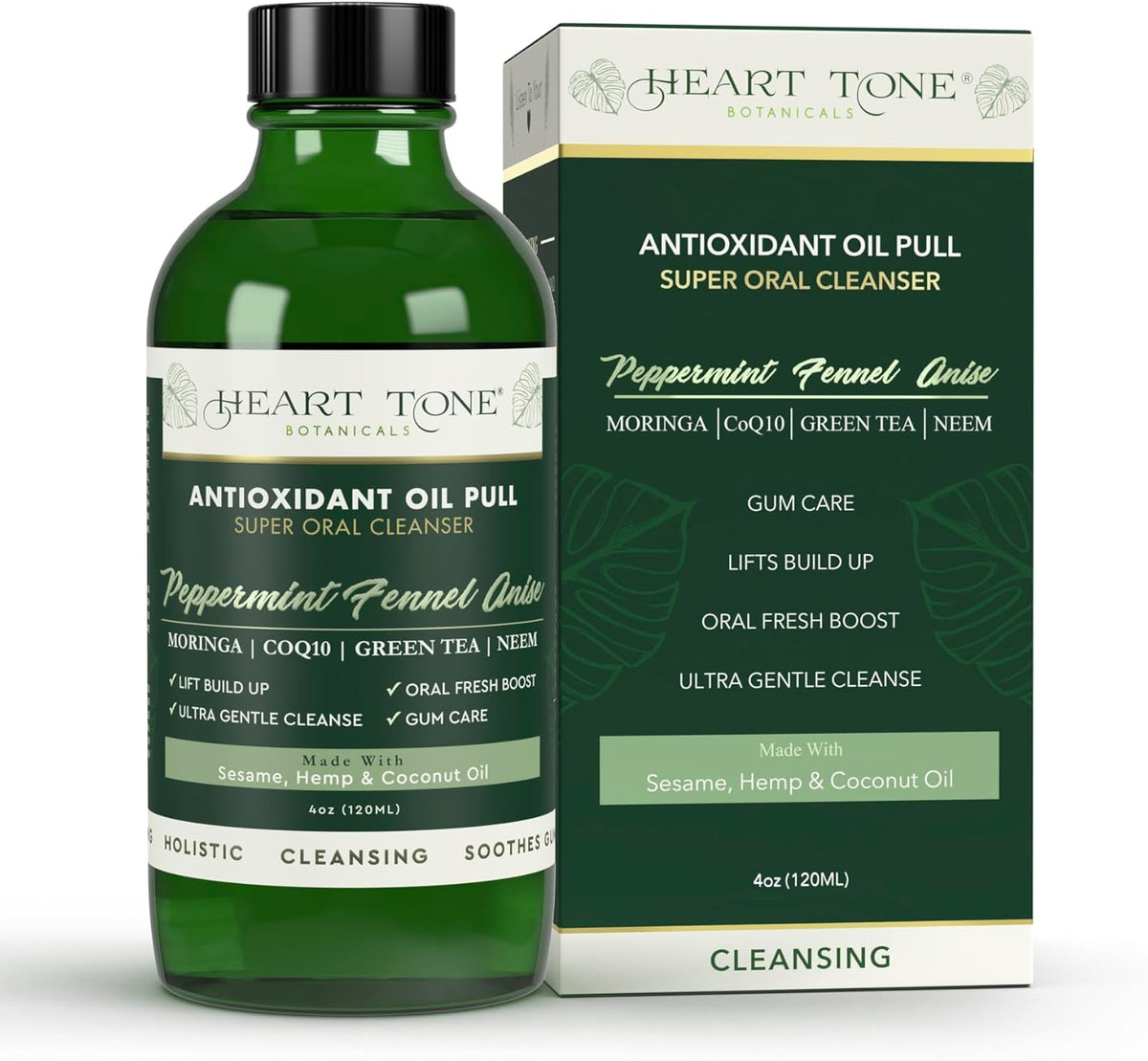
Formula note: Heart Tone's current oil pull product pages list sesame/coconut oil bases with botanicals such as myrrh, manuka, green tea, tea tree, turmeric, licorice root, peppermint, fennel, and anise; the Ozonated Oil Pull also lists ozonated sesame oil, CoQ10, and resveratrol. This article is educational and should not be read as saying every botanical discussed here appears in the current Heart Tone oil pull formulas. Always refer to the product label for the exact ingredient list.
How to Read "Tea" on an Ingredient List
This is the practical takeaway, and it applies well beyond one brand. When you see something tea-related on a label, check the botanical name and the plant part:
- Camellia sinensis leaf — green tea. A leaf extract, used in small amounts.
- Camellia oleifera seed — camellia or tea seed oil. A pressed carrier oil, used structurally.
- Melaleuca alternifolia — tea tree. Not a tea plant at all, despite the name; a completely separate species and an essential oil.
All three can legitimately be described as "tea" something in casual writing, and all three behave differently in a formula. The Latin binomial and the plant part are what settle it — which is exactly why good ingredient lists print both.
Working It Into a Routine
Oil pulling is a morning ritual for most people who keep it up: a tablespoon before eating or drinking, a gentle swish for five to fifteen minutes with no need to work at it, then spit into the trash rather than the sink, since oil will build up in pipes over time. Rinse with water and continue with the rest of your routine.
If you are new to the practice and want the full walkthrough rather than the ingredient detail, start here.
The Bottom Line
Camellia seed oil is one of those ingredients that is easy to misread precisely because its name is familiar. It is not green tea, it is not tea tree, and it is not a botanical extract added at a fraction of a percent. It is a light, oleic-rich carrier oil pressed from the seeds of the tea plant, sitting in the first third of both Heart Tone oil pulling formulas, doing the unglamorous structural job of making a fifteen-minute swish feel like something you would repeat tomorrow.
Explore the full natural oral care collection from Heart Tone Botanicals.

Leave a comment
This site is protected by hCaptcha and the hCaptcha Privacy Policy and Terms of Service apply.