












The Short Answer: Same Goal, Very Different Grit

Baking soda toothpaste and charcoal toothpaste get lumped together as "natural" alternatives to a standard mint gel, but they don't feel anything alike on a toothbrush. One is a fine, slightly gritty mineral powder that's been used in oral care for well over a century. The other is a fine black powder that's had a moment on social media for the last several years. Choosing between them comes down to texture, daily comfort, and how much abrasion you actually want on your enamel — not which one is "more natural."
What "Abrasivity" Actually Means
Every toothpaste — natural or conventional — has an abrasivity value, often referenced by dental professionals as RDA (Relative Dentin Abrasivity). It's simply a measure of how much surface material a paste removes under normal brushing pressure, tested against a standardized reference. Higher-RDA pastes tend to feel grittier and work faster on surface residue; lower-RDA pastes feel smoother and gentler, especially over years of twice-daily use. Neither number tells you whether an ingredient is "natural" — it's purely about particle size and hardness.
This is the number worth paying attention to when you're comparing baking soda and charcoal, because both ingredients sit toward the higher end of the abrasivity range compared to clay-based or gel formulas.
Baking Soda Toothpaste: What It Feels Like
Sodium bicarbonate — baking soda — is a fine, water-soluble mineral powder. On a toothbrush it dissolves into a light foam with a distinctly salty, slightly sharp taste that some people love and others need time to get used to. Its particles are relatively small and uniform, which is part of why it's been a household staple for generations: it feels thorough without feeling like sandpaper.
Baking soda toothpaste also tends to run mildly alkaline, which is one reason it's associated with a "squeaky clean" mouthfeel right after brushing. That sensation fades as saliva neutralizes it back to normal within a few minutes — it isn't a lasting change, just a temporary feel.
Charcoal Toothpaste: What It Feels Like
Activated charcoal is a much coarser, more porous material than baking soda. It's typically ground from coconut shells or hardwood and processed to increase surface area. On a toothbrush it feels gritty and chalky, and — the part every first-time user underestimates — it's black. It will stain a white sink, a toothbrush, and grout if you're not careful with rinsing.
Charcoal's porous structure is the whole reason it's marketed for surface polish: the particles are irregular and physically abrasive, which is exactly why dental professionals generally recommend using charcoal formulas only a few times a week rather than as a twice-daily paste. Daily use of a high-abrasion powder is harder on enamel over time than an occasional-use product, simply due to the cumulative physical wear.
Baking Soda vs. Charcoal: Side by Side
- Texture: Baking soda is fine and dissolves into foam; charcoal is coarse, porous, and stays gritty through the whole brush.
- Taste: Baking soda is salty and mineral-forward; charcoal is typically flavorless on its own, so formulas lean on mint oils to make it palatable.
- Mess: Baking soda rinses clean; charcoal can stain a sink, towel, or grout if it isn't rinsed immediately.
- Frequency: Baking soda is generally considered gentle enough for daily use; charcoal is more commonly recommended a few times a week given its coarser grit.
- History: Baking soda has been used in oral care since the 1800s; charcoal's current popularity is a recent trend, even though charred materials have a long history in traditional practices around the world.
What This Means for Everyday Brushing
If your priority is a gentle formula you can use morning and night without thinking twice, a fine mineral abrasive — baking soda, kaolin clay, or a blend — is generally the more comfortable daily choice. If you're specifically after the deep-polish feeling charcoal delivers, supporting it as an occasional addition to your routine rather than a full replacement keeps the abrasion in check.
Either way, reading the ingredient label matters more than the marketing on the front of the box. A "charcoal toothpaste" that's mostly glycerin and water with a pinch of charcoal for color will feel very different from one where charcoal is a primary ingredient — and the same goes for baking soda formulas padded out with fillers.
A Clay-Based Alternative to Both
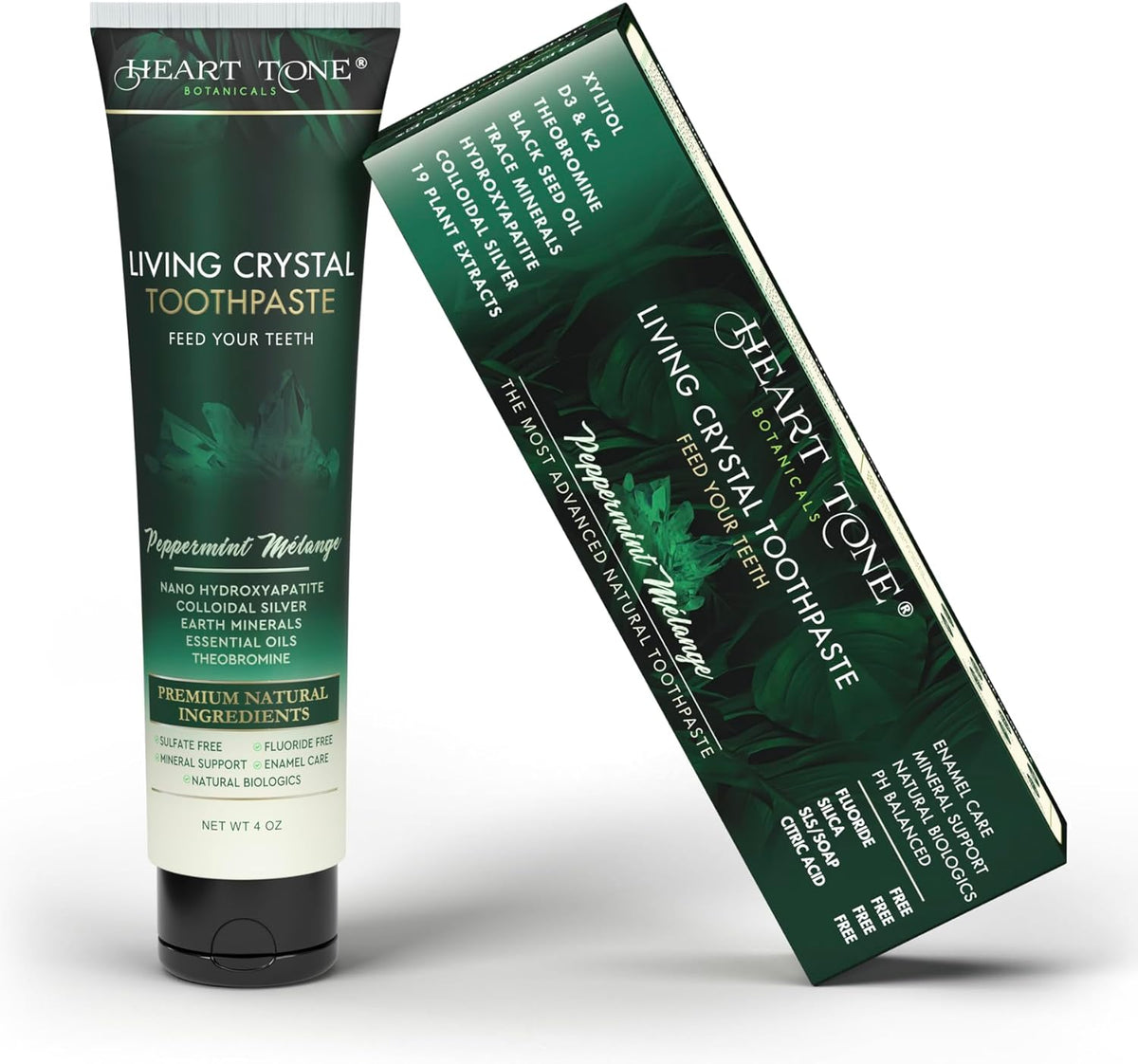
Not every natural toothpaste has to choose between "gritty mineral powder" and "gritty carbon powder." Living Crystal Toothpaste takes a different route: kaolin clay and bentonite clay do the polishing work, alongside micro-hydroxyapatite for texture. Sodium bicarbonate is part of the formula, but it sits well down the ingredient list rather than serving as the primary abrasive — so the overall feel is smoother and less salty than a baking-soda-forward paste, without the mess or staining risk of a charcoal formula. It's fluoride-free, built on 30+ farm-grown botanical extracts, and formulated for everyday use rather than an occasional deep-polish treatment.
To round out the routine, Restorative Mouth Rinse is an alcohol-free rinse built on farm-grown aloe vera, colloidal silver, and a full botanical mint complex — a comfortable, non-drying finish after brushing, whichever toothpaste texture you land on.
The Bottom Line
Baking soda and charcoal toothpaste both fall on the more-abrasive end of the natural toothpaste spectrum, but they get there in very different ways — fine mineral powder versus coarse porous carbon. Neither is automatically "better"; it depends on how much grit you want on a daily basis and how much cleanup you're willing to do. If you'd rather skip the abrasivity math altogether, a clay-based formula gives you a smoother middle ground.
Explore the full natural oral care collection from Heart Tone Botanicals to find the texture that fits your routine.

Leave a comment
This site is protected by hCaptcha and the hCaptcha Privacy Policy and Terms of Service apply.