

Colloidal gold keeps appearing in luxury and clean beauty formulas. But unlike many trending ingredients, it has a genuine history in both traditional use and emerging research — and a specific mechanism that makes it worth understanding before writing off as marketing.
This article explains what colloidal gold is, how it behaves in a skincare formula, what early research shows about gold nanoparticles on skin, and why it appears alongside colloidal silver, snow mushroom, and methylene blue in a modern botanical toning mist.
What Colloidal Gold Actually Is
Colloidal gold is gold in nanoparticle form — tiny gold particles (typically 1–100 nanometers) suspended evenly throughout a liquid base rather than dissolved in it. The particles are too small to see individually, but they scatter light in a way that gives the liquid a characteristic ruby-red or purple hue depending on particle size and concentration.
This is different from gold flakes in face masks, which are decorative. Colloidal gold uses particles small enough to interact with skin chemistry at a cellular level.
Gold nanoparticles carry a net negative surface charge that plays a central role in how they interact with skin tissue — particularly with oxidative molecules and inflammatory signals.
The Antioxidant Behavior of Gold Nanoparticles
Gold nanoparticles are studied in materials science for their electron transfer properties. In a biological context, this means they can accept electrons from reactive oxygen species (ROS) — the free radicals associated with UV exposure, pollution, and daily metabolic stress on skin.
This electron-sink behavior is what gives colloidal gold its antioxidant profile. Rather than donating electrons (like vitamin C or resveratrol), gold nanoparticles neutralize free radicals by accepting them — a distinct mechanism that complements conventional antioxidants.
Colloidal gold's antioxidant action works through electron transfer, not electron donation — which means it functions differently from standard vitamin antioxidants and can provide complementary protection in the same formula.
Anti-Inflammatory Research
Lab research on gold nanoparticles in skin contexts has grown over the past decade. Studies using cell culture models have observed that gold nanoparticles at appropriate concentrations reduce the expression of pro-inflammatory cytokines including TNF-α and IL-6 — markers associated with skin inflammation, redness, and reactive skin conditions.
A 2022 review in the International Journal of Molecular Sciences summarized the anti-inflammatory potential of gold nanoparticles in dermatological applications, noting their ability to modulate macrophage activity and reduce NF-κB signaling — the same pathway targeted by curcumin and other botanical anti-inflammatories.
This is still early-stage research, primarily in vitro and in animal models. Clinical human trials are limited. But the mechanistic basis is solid and gives formulators genuine reason to include colloidal gold in skin-supportive formulas.
Gold Nanoparticles and Skin Penetration
The size of gold nanoparticles matters for how they interact with skin. Particles under 10 nanometers can penetrate into the upper layers of the stratum corneum. Larger particles (20–50nm) tend to remain at the surface and concentrate around hair follicles, which are natural delivery channels for lipid-soluble and nanoparticle ingredients.
Hydrosol delivery — suspending colloidal gold in a water-based botanical mist — takes advantage of this surface interaction. When misted onto clean skin, the fine droplets allow colloidal gold to settle evenly across the skin surface and around follicular openings without the occlusion that comes with heavier oil or cream vehicles.
How to Identify Real Colloidal Gold
Not all gold in skincare is colloidal gold. Here's how to distinguish them:
- Colloidal gold — nanosized particles suspended in liquid. Listed as "Colloidal Gold" or "Aurum" in INCI lists. Has measurable antioxidant potential. Often red or purple-tinted at higher concentrations.
- Gold flakes — decorative metallic sheets. Large particles, no meaningful skin interaction. A visual marketing ingredient, not a functional one.
- Gold-colored products — often don't contain gold at all. Yellow tint comes from botanical extracts or colorants, not metal particles.
In an INCI list, look for "COLLOIDAL GOLD" specifically. It will appear in functional ingredients rather than colorants or fragrance components.
Colloidal Gold in a Multi-Active Toning Formula
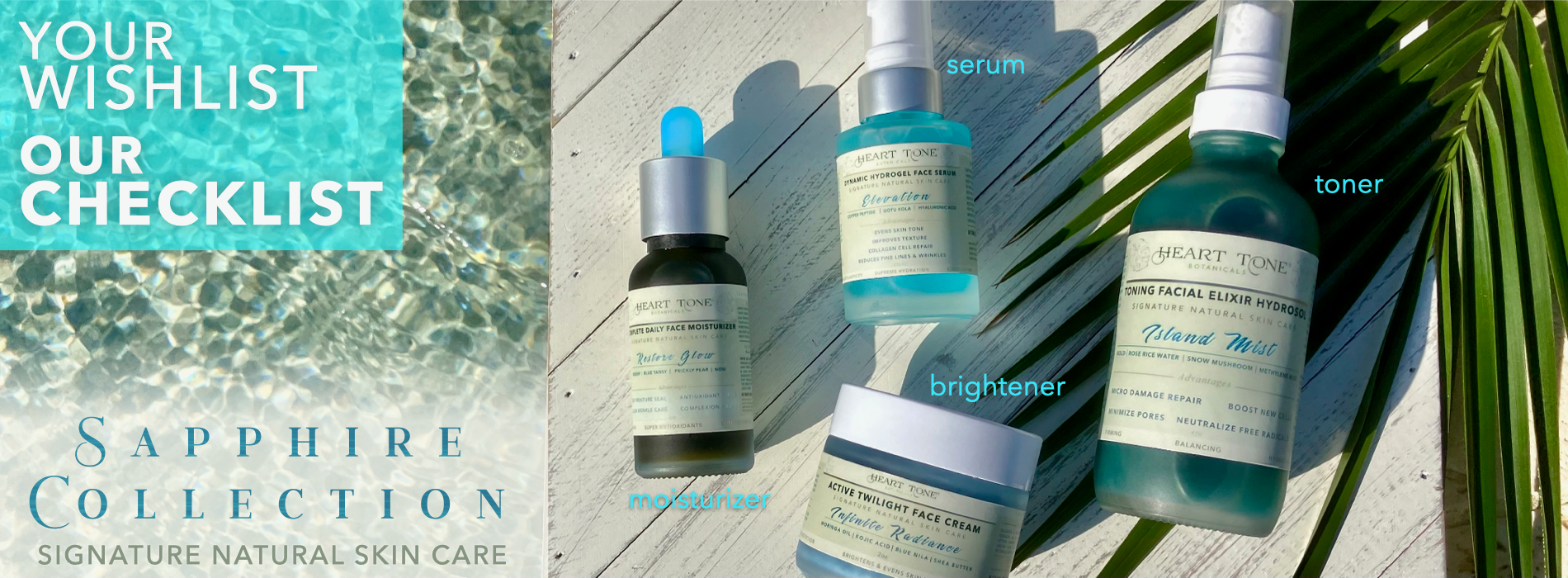
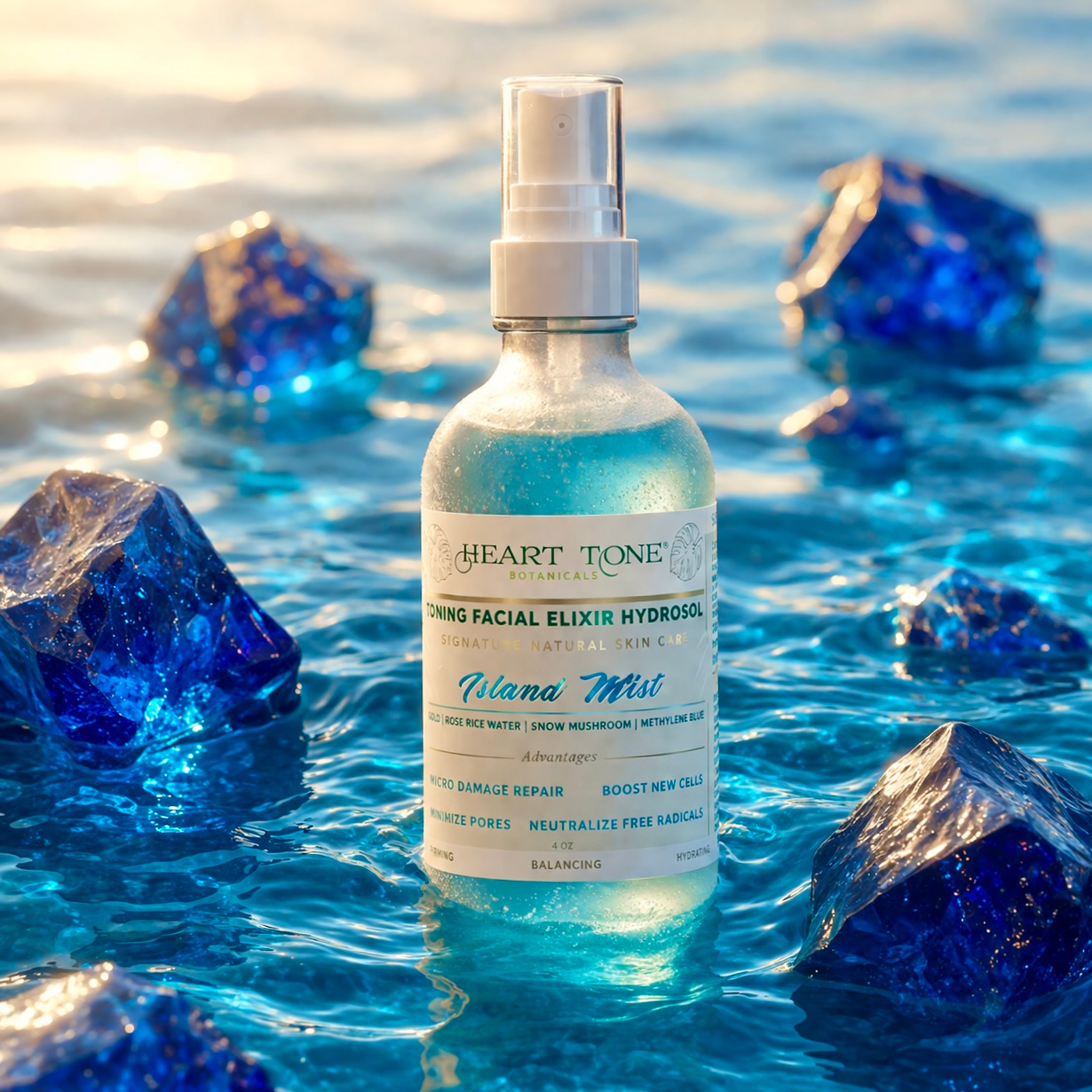
The most interesting thing about colloidal gold in Island Mist Toning Facial Elixir Hydrosol is what it's paired with. The formula contains:
- COLLOIDAL SILVER — a second redox-active metal with established traditional use in skin wellness
- SNOW MUSHROOM EXTRACT (Tremella fuciformis) — branched polysaccharides that hold significantly more moisture than hyaluronic acid by volume
- METHYLENE BLUE — a redox-active organic compound studied for mitochondria-targeting antioxidant behavior
- FRANKINCENSE SERRATA CO2 EXTRACT — boswellic acid fraction with 5-lipoxygenase (5-LOX) inhibition activity
- FERMENTED ORGANIC RICE WATER — ferulic acid and bioavailable amino acids via fermentation
- ROSE AND ORANGE BLOSSOM HYDROSOLS — botanical water bases with natural aromatic compounds
This combination creates a layered antioxidant and hydration formula. Colloidal gold and methylene blue address oxidative stress through two distinct electron-transfer mechanisms. Snow mushroom provides structural hydration. Frankincense CO2 addresses the 5-LOX inflammatory pathway. Fermented rice water supports barrier function with fermentation-enhanced bioavailability.
How to Use a Colloidal Gold Toning Mist
A hydrosol toner with colloidal gold works best when used correctly in a layered routine:
- Cleanse first. Apply to clean, freshly washed skin. Residue from previous products can interfere with how nanoparticles settle on skin.
- Mist at 6–8 inches. A fine, even mist creates better surface distribution than a close spritz.
- Let it absorb for 60 seconds before layering a serum or moisturizer on top.
- Can be used AM and PM. Antioxidant protection is particularly valuable in the morning (before sun exposure); the hydrating ingredients support overnight barrier repair in PM use.
- Use over makeup for a midday hydration refresh — the mist format works as a setting and refreshing layer without disturbing foundation.
Gold nanoparticles work at the surface level — they don't need to be massaged in or left on for extended time. A 60-second settle before your next product is enough.
The Bigger Picture: Redox-Active Ingredients in Clean Beauty 2026
The trend worth noting is that colloidal gold, colloidal silver, and methylene blue are all redox-active ingredients — they interact with free radicals through electron transfer rather than classical antioxidant donation. This is a different generation of skin protection than the vitamin C and vitamin E antioxidants that dominated clean beauty for decades.
Formulators are increasingly pairing multiple redox mechanisms in a single formula for complementary protection across different oxidative pathways. Island Mist represents this approach — three distinct redox-active compounds (colloidal gold, colloidal silver, methylene blue) alongside hydration and botanical anti-inflammatory support.
Frequently Asked Questions
Is colloidal gold safe for daily use on the face?
At concentrations used in skincare formulas, colloidal gold is well tolerated by most skin types. Pure colloidal gold is inert at the elemental level — skin reactions are more often related to the carrier liquid or other formula ingredients than to the gold particles themselves. If you have a nickel or metal sensitivity, patch-test first as a precaution, though gold is distinct from nickel in both chemistry and biological interaction.
Can colloidal gold actually brighten skin?
No direct skin-brightening evidence exists for gold nanoparticles specifically. If you're looking for targeted brightening (dark spots, hyperpigmentation), tyrosinase inhibitors like kojic acid dipalmitate, licorice root extract, or vitamin C are more evidence-supported for that specific goal. Colloidal gold's role in Island Mist is antioxidant and anti-inflammatory support, not pigmentation correction.
Is there a difference between colloidal gold and nano gold?
Colloidal gold is nano gold — the terms refer to the same material. "Colloidal" describes the suspension state (particles dispersed in liquid), while "nano gold" or "gold nanoparticles" describes the particle size range. In INCI nomenclature, you'll typically see "Colloidal Gold" or "Aurum" on the ingredient label.
Will colloidal gold in a toner oxidize or expire quickly?
Gold nanoparticles are among the most chemically stable materials in skincare. Unlike vitamin C, which degrades rapidly when exposed to air and light, gold doesn't oxidize under typical storage conditions. Suspension stability is the main concern — well-formulated colloidal gold products should remain stable for 12–24 months. Island Mist is formulated in a UV-protective bottle to preserve all light-sensitive actives including methylene blue and the botanical extracts.
Complete Your Botanical Skin Routine
- Snow Mushroom Extract for Skin: What Tremella Does for Your Face
- Methylene Blue in Skincare: What This Longevity Compound Does
- Natural Face Moisturizer with Botanical Ingredients: What to Look For
- Complete Daily Face Moisturizer
- Dynamic Hydrogel Face Serum
- Full Facial Care Collection
Also in the Island Mist Ingredient Series: Fermented Rice Water for Skin: The East Asian Beauty Tradition Explained

Leave a comment
This site is protected by hCaptcha and the hCaptcha Privacy Policy and Terms of Service apply.