












The Short Answer: It Depends on What’s in the Other 80 Percent

If you’ve picked up a “certified organic” body lotion and noticed it vanished into your skin in seconds — leaving you reaching for more a few minutes later — you’ve already encountered the core problem. Most conventional lotions, even the organic ones, are water-first formulas. Water is the first ingredient and makes up anywhere from 60 to 80 percent of the product.
That’s not inherently a problem. But when “organic” on the front label is mostly describing the water — or a small organic fraction of a largely conventional formula — it’s worth knowing what you’re actually buying before you choose between a lotion and something more concentrated.

What “Organic” Actually Means on a Body Lotion Label
The USDA Organic seal means at least 95% of the agricultural ingredients in a product are certified organic. “Made with organic ingredients” is a lower bar — at least 70% organic by agricultural content. And “organic [ingredient name]” in a product title often just means one or a few ingredients in an otherwise-conventional formula happen to be organic.
Here’s the complication: lotion is mostly water. Water is not an agricultural ingredient, so it doesn’t count toward the organic percentage calculation. A body lotion can carry an “organic” designation while being 70% water — with the remaining ingredients including synthetic emulsifiers, synthetic preservatives, and fragrance.
This doesn’t make organic lotion a bad choice. It means “organic” on a body lotion label tells you something about the agricultural fraction of the ingredient list — not about the formula as a whole. Reading the full ingredient list gives you the complete picture.
What Most Conventional Lotions Actually Contain
Whether they’re labeled organic or conventional, most body lotions follow a predictable structure:
- Water (aqua): Usually the first and largest ingredient — often 60–80% of the total formula
- Humectants: Glycerin is the most common, drawing surface moisture
- Emulsifiers: Ingredients like cetearyl alcohol that hold the oil and water phases together
- Emollients and conditioning agents: Shea butter, jojoba oil, coconut oil — the ingredients that give lotion its skin feel. In many formulas, these are a minority fraction of the total
- Preservatives: Required in any water-containing formula
- Fragrance or essential oils
This is a functional, time-tested approach. But if you’re choosing a lotion for the feel of shea butter, kokum butter, or meadowfoam seed oil, those ingredients may represent 3–10% of the actual formula. The rest is structure and dilution.
When Body Butter Is the Better Choice
A body butter eliminates the water phase entirely. That one change has downstream effects on the whole formula:
- No water means no emulsifiers needed to hold an oil-and-water blend together
- No water means no synthetic preservatives are required
- The high-value butters and oils can make up the majority — or entirety — of what’s in the jar
The result is a richer, more concentrated product. Body butter takes a little longer to absorb than a water-based lotion, but leaves a noticeably different feel on the skin — particularly for elbows, knees, heels, or hands that need more than a quickly-absorbing lotion can deliver.
The practical note: body butter works best applied right after a shower while skin is still warm. A small amount goes further than you’d expect — the formula is concentrated, not diluted.

Botanical Ingredients With a Long Tradition in Skin Care
When comparing formulas — lotion or butter — here are the ingredients worth recognizing and what they bring:
Virgin Nilotica Shea Nut Butter
Nilotica shea comes from the Vitellaria paradoxa nilotica variety, found in East Africa along the Nile basin — a different species from the West African shea more commonly seen in conventional products. Nilotica shea has a softer, more fluid consistency. It absorbs more readily than standard shea and leaves a silky feel rather than the waxy finish some people associate with conventional shea butter. It has been used in traditional East African skin care preparations for generations and is considered one of the finer shea varieties for cosmetic use.
Kokum Butter
Kokum butter is cold-pressed from the seeds of Garcinia indica, a tree native to India’s Western Ghats. It is one of the firmest plant butters — dense and stable — with a long history of use in Ayurvedic and traditional Indian botanical preparations. In a body butter formula, kokum contributes structure and a clean, non-greasy feel. It has been valued in traditional handcrafted skin preparations for its stable, firm character.
Meadowfoam Seed Oil
Meadowfoam (Limnanthes alba) is a flowering plant native to the Pacific Northwest. Its seeds produce an oil with an unusually stable lipid profile and a distinctly light, non-greasy sensory character. In body butter formulas, meadowfoam seed oil is often responsible for the dry-touch finish — the quality that distinguishes a well-formulated body butter from heavier, greasier alternatives. It has gained a strong following in natural cosmetics for its sensory profile.
Elderberry Extract
Elderberries (Sambucus nigra) have been used in botanical preparations across Europe and North America for centuries. In skincare formulations, elderberry extract has a long tradition of use as a botanical ingredient. It contributes botanical character and visual interest to formulas that include it.
Organic Arrowroot Powder
Arrowroot (Maranta arundinacea) is a fine starch derived from a tropical plant with a long history of use in natural personal care preparations. In body butters specifically, arrowroot powder is the ingredient most responsible for the dry-touch, non-sticky finish — it absorbs surface oils and keeps the formula feeling silky rather than heavy. It’s one of the most practical textural ingredients in a water-free formula.
Vitamin E
Vitamin E (tocopherol) is a naturally occurring compound found throughout the plant world, particularly in seed and nut oils. In body butters and natural cosmetics, it plays a supporting role as a natural antioxidant that protects the plant oils in the formula from oxidizing over time — helping the product maintain its character during use. It has a long and consistent history of use in natural cosmetic formulations.
What a Clean Ingredient List Should Leave Out
Whether you’re choosing a lotion or a body butter, here’s what a genuinely clean formula should skip:
- Synthetic fragrance (“fragrance” or “parfum”): A single fragrance listing can contain dozens of individual compounds not disclosed on the label. Named essential oils are a more transparent choice
- Parabens (methylparaben, propylparaben, etc.): Synthetic preservatives widely used in conventional body care
- Mineral oil or petrolatum: Petroleum-derived ingredients that work differently from plant-based oils
- PEGs (polyethylene glycols): Synthetic emulsifiers and humectants common in conventional formulas
- Synthetic dyes: No functional purpose in a skin-care product
A genuinely clean botanical body butter will have a short, recognizable ingredient list — butters, oils, botanical extracts, and essential oils. If you can identify most of what’s in it, that’s a good starting point.
Building a Complete Natural Body Care Routine
A botanical body butter works best as part of a layered routine. Here’s a simple framework:
Step 1 — Cleanse: Start with an organic soap or castile liquid soap that cleans without stripping. The Ancient Organic Soaps from Heart Tone Botanicals are cold-pressed with organic oils and farm-grown botanicals — available in Aloe Fields, Alpha Bar, and Coconut Creme. For a liquid option, the Herbal Castile Liquid Soap and Faithfully Pure Hands Castile (in four scent profiles) are versatile for body and household use. For a more traditional exfoliating experience, the Moroccan Exfoliating Black Soap is made with organic olive oil and traditional Moroccan black olive paste.
Step 2 — Lightweight botanical layer (optional): The Botanical Skin Gel is a lightweight gel made with organic aloe vera, colloidal silver, and farm-grown botanical extracts including calendula and willow bark. It absorbs quickly and works as a lighter step before a richer body butter application.
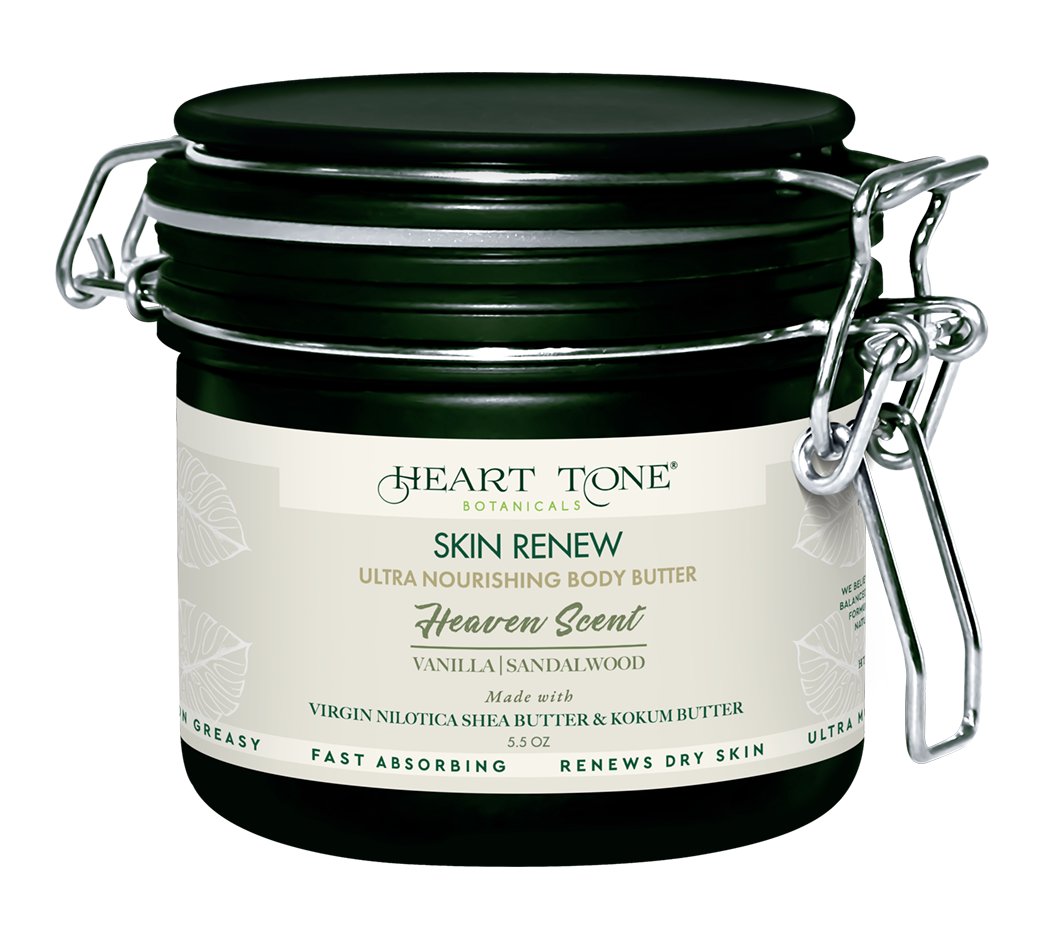
Step 3 — Body butter: Apply the Botanical Renew Body Butter while skin is still warm from the shower. Formulated with Virgin Nilotica Shea Nut Butter, Kokum Butter, Meadowfoam Seed Oil, Elderberry Extract, and Organic Arrowroot Powder for a non-greasy finish. Available in three scent profiles: Heavenly Scent (vanilla + sandalwood), Bohemia (bergamot + lemon verbena), and Day Dream (lavender + chamomile + neroli).
Step 4 — Natural deodorant: Complete the routine with an aluminum-free deodorant. The Bioactive Deodorant line includes Eden’s Garden (lavender + clary sage), Grove Island (citrus blend), Jamaica Estate (bergamot + frankincense), Gentleman’s Reserve (woodsy), and The Classic (fragrance-free). All are aluminum-free, baking-soda-free, and made without synthetic fragrances.
The Bottom Line
“Organic body lotion” describes a wide range of products — from water-heavy formulas with a small organic fraction to genuinely concentrated botanical options. Reading the full ingredient list tells you more than the front-of-label claims ever will.
If you’re looking for a formula that puts Nilotica shea, kokum butter, and meadowfoam seed oil at the center — without water dilution, synthetic emulsifiers, or synthetic preservatives — a botanical body butter is a fundamentally different product from what most “organic lotion” labels are offering.
Explore the full Heart Tone Botanicals body care line at htbotanicals.com/collections/body-care.

Leave a comment
This site is protected by hCaptcha and the hCaptcha Privacy Policy and Terms of Service apply.