












When Brushing Starts to Feel Like a Problem

Many people with sensitive teeth know this moment: a sharp, fleeting jolt when they sip something cold, eat ice cream, or step out into winter air with their mouth slightly open. Brushing — which should feel clean and refreshing — can become something they brace for.
The conventional response is the drugstore "sensitive" shelf. Products there typically rely on OTC drug actives — potassium nitrate or stannous fluoride — which are regulated by the FDA as drug ingredients. That's how the label claim "for sensitive teeth" is permitted on those formulas.
If you're looking for a toothpaste that stays entirely on the botanical, cosmetic side — no drug actives, no synthetic additives — those products aren't where you want to look. But that doesn't mean you're without options. It means understanding the formula itself matters more than you might expect.
The Real Reason Some Toothpastes Make Things Worse
Not all tooth sensitivity has the same origin, but one underappreciated factor is what's in the toothpaste. Some formulas actively contribute to oral discomfort — not because of what they're designed to do, but because of ingredients included for texture, lather, or shelf life:
Sodium Lauryl Sulfate (SLS)
SLS is a synthetic foaming agent added to most conventional toothpastes to create the vigorous lather many people associate with "clean." It has no cleaning function — it's purely there for sensory perception. For many users, SLS contributes to a feeling of oral sensitivity and dryness after brushing — a peeling or sloughing sensation in the cheeks and along the gumline that some people notice with daily use. For anyone whose oral tissues are easily irritated, a toothpaste without SLS often produces a noticeably more comfortable brushing experience.
High Abrasivity
Toothpaste abrasivity is measured on the Relative Dentin Abrasivity (RDA) scale, from 0 (no abrasion) to 200+. Most mainstream brightening pastes run RDA 90–150. Formulas marketed for "deep clean" or "tartar control" can be even higher. For sensitive teeth, a lower-abrasion formula — generally RDA 70 or under — provides thorough cleaning without harsh surface friction on the gum margin and exposed tooth structure.
These two factors — SLS content and abrasivity level — are worth checking before assuming that discomfort during brushing is purely a tooth structure problem.
Botanical Ingredients With a Long History in Gentle Oral Care
A natural toothpaste built for comfort relies on gentle physical properties and botanical ingredients with long traditions in oral hygiene. Here's what distinguishes a serious formula from a tokenized one:
Hydroxyapatite
Hydroxyapatite is the naturally occurring calcium phosphate mineral that makes up the primary structural component of both tooth enamel and dentin. It has been used in Japanese oral care formulations since the 1980s and has a decades-long history in natural dentistry internationally. In toothpaste, it functions as an ultra-fine polishing agent — one with a silky, smooth character that leaves teeth feeling clean without surface harshness. Because its mineral composition mirrors the structure of the teeth it's cleaning, it's one of the most comfortable polishing agents available.
Kaolin Clay
A fine, white mineral clay, kaolin has been used in cosmetic and personal care formulations across cultures for centuries. In toothpaste, it functions as a mild mechanical cleaning agent with naturally low abrasivity — making it a natural choice for low-RDA formulas. It produces a clean, polished sensation without grit or harshness, and contributes to a smooth, non-foaming brushing experience.
Farm-Grown Aloe Vera
Aloe vera has been a part of traditional oral care for a very long time — its soothing, non-drying character made it a natural fit for mouth rinses and pastes long before it found its way into modern cosmetics. In toothpaste, aloe vera contributes a gentle, comfortable feel on oral tissues. It tends to reduce the foaming that comes with SLS, supporting a quieter, more comfortable brushing sensation — particularly appreciated by people who find high-lather formulas too stimulating.
Colloidal Silver
Colloidal silver has been used in traditional oral care formulations for centuries. In toothpaste, it contributes to a fresh, clean sensation without the sharp medicinal character of alcohol or synthetic antiseptics. Its history in natural personal care formulations is long and well-established — and unlike alcohol, it leaves the mouth feeling clean rather than dry.
Xylitol from Birch Wood
Xylitol is a naturally occurring sugar alcohol found in birch wood, corn cobs, and many fruits and vegetables. It has been used in Scandinavian oral care tradition for decades and is now a standard ingredient in natural toothpaste formulas worldwide. It contributes a clean, pleasant sweetness to the brushing experience — without the artificial sweeteners (saccharin, aspartame) that appear in most conventional pastes.
What to Avoid If Your Mouth Is Easily Irritated
Even within the "natural" category, not every formula is equally appropriate for people who brush with sensitivity in mind. A few things to look for on the label:
- SLS (sodium lauryl sulfate) — common in conventional and some "natural" pastes; a documented soft-tissue irritant for many users
- High-RDA abrasives — aggressive silica blends, coarse charcoal powders, or heavy baking soda concentrations can be hard on gum tissue
- Alcohol — occasionally appears in gel-style toothpastes as a preservative; creates a drying, astringent effect on oral tissue
- Artificial sweeteners — saccharin and aspartame have no place in a clean-formula toothpaste; some users find them irritating at daily exposure levels
- Synthetic fragrance compounds — artificial mint flavoring is often stronger than natural peppermint and can cause its own oral tissue sensitivity in some users
The goal isn't to find a formula that does as little as possible — it's to find one where every ingredient is there for a reason, and nothing is there that works against comfort during daily use.
A Low-Abrasion Botanical Formula Built for Daily Comfort
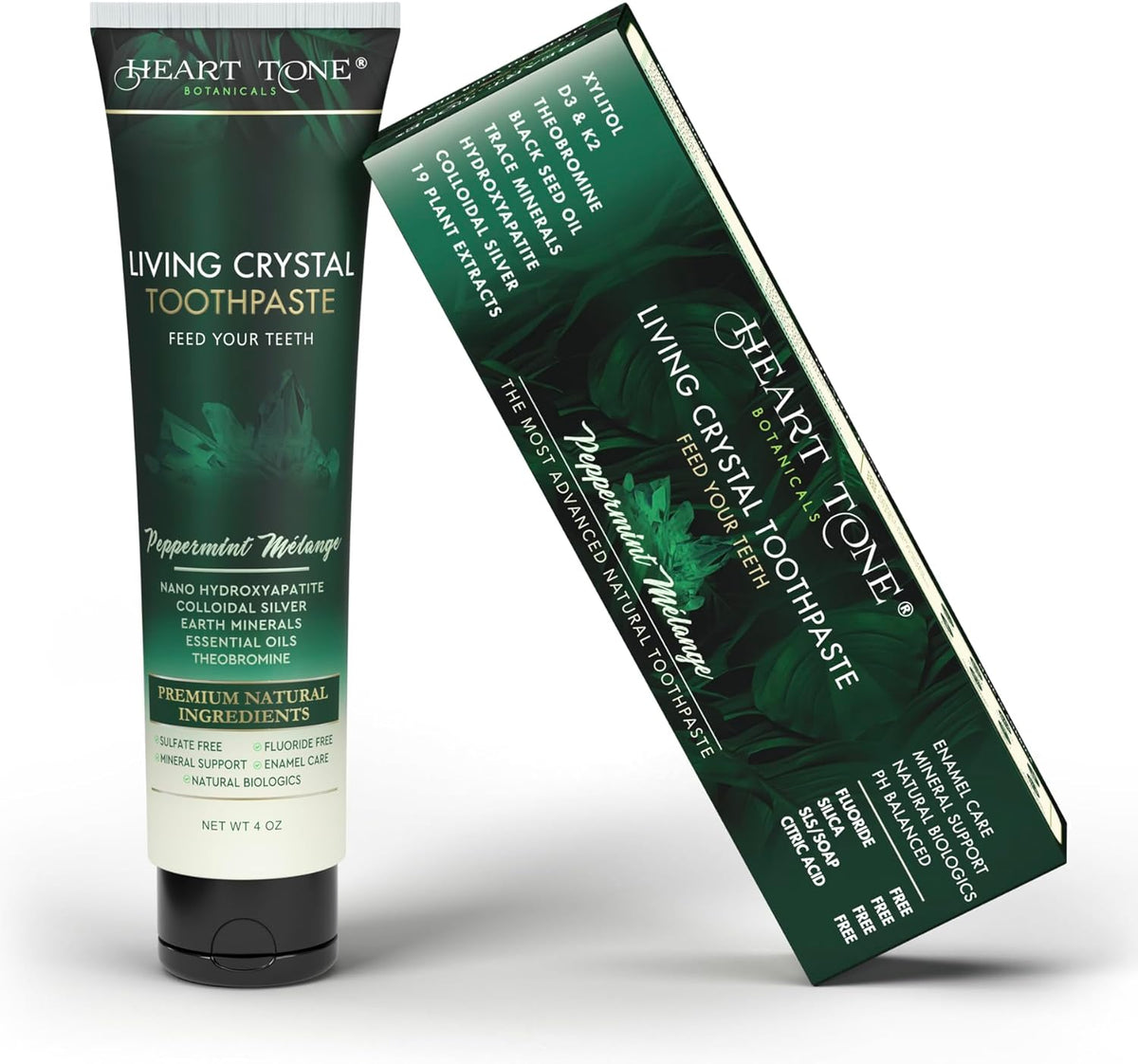
Heart Tone Botanicals' Living Crystal Toothpaste was formulated with a target RDA of 35 — making it one of the lowest-abrasion natural toothpastes available, confirmed by independent lab testing. It contains no SLS, no fluoride, no alcohol, no artificial sweeteners, and no synthetic preservatives or fragrances.
The formula includes pharmaceutical-grade hydroxyapatite, farm-grown aloe vera, kaolin clay, birch-derived xylitol, colloidal silver, and a curated blend of botanical extracts — all ingredients with established traditions in natural oral care. It's a formula that earns its place in a twice-daily routine without adding anything that works against the comfort it's designed to support.
Completing the Routine: A Gentle Mouthwash Matters Too
For sensitive teeth, toothpaste is only part of the story. A conventional alcohol-based mouthwash — used after careful brushing — can undo much of the comfort you worked to achieve. Alcohol is a drying agent, and leaving oral tissues dry creates its own discomfort and sensitivity.
Heart Tone Botanicals' Restorative Mouth Rinse is alcohol-free, built around colloidal silver, farm-grown aloe vera, and 18 botanical extracts. It contributes a lasting fresh sensation without the burn or dryness of conventional formulas — and it's gentle enough for morning and evening use alongside a low-abrasion toothpaste.
Together, a low-RDA botanical toothpaste and an alcohol-free botanical rinse make a complete gentle routine — one where every step reinforces comfort rather than working against it.
Explore the full natural oral care collection to see the complete range of clean-formula options for daily mouth care.

Leave a comment
This site is protected by hCaptcha and the hCaptcha Privacy Policy and Terms of Service apply.