












The Short Answer: It Depends on What's Actually in the Bottle

If you've been searching for a natural body wash, you've probably noticed that the label doesn't always tell the full story. Products marketed as "natural," "clean," or "plant-based" can still contain synthetic sulfates, artificial fragrance compounds, and chemical preservatives — right alongside the botanical claims on the front of the bottle.
So what actually separates a genuinely natural body wash from a conventional one? The ingredient list. Here's what centuries of botanical tradition look like in your shower — and what to leave on the shelf.
What Conventional Body Wash Does That Natural Formulas Don't
Most conventional body washes are built around sodium lauryl sulfate (SLS) or sodium laureth sulfate (SLES) as their primary cleansing agents. These synthetic surfactants produce a rich lather effectively — but they're also effective at stripping the skin of the natural oils that help it feel balanced and comfortable after washing.
For people with sensitive or dry skin, that stripping effect can leave the skin feeling tight, dry, and uncomfortable after every shower. Synthetic fragrance — listed as "fragrance" or "parfum" on a label — adds another layer of complexity: that single term can represent dozens of undisclosed aromatic compounds.
Natural body wash takes a different approach: plant-derived cleansers, real botanical ingredients, and a gentler daily experience — starting with what the formula does not contain.
Ingredients That Define a Genuinely Natural Body Wash
Plant-Derived Surfactants
The cleansing agents in a natural body wash should come from plant sources, not petroleum. Two of the most common plant-derived surfactants are coco-glucoside and decyl glucoside, both derived from coconut oil and plant glucose. They produce a gentle, conditioning lather without the drying effect associated with synthetic sulfates.
Traditional castile soap — made from saponified plant oils — is another cornerstone of natural cleansing with roots stretching back centuries across the Mediterranean and Middle East. It has been used as a daily body cleanser in those traditions for generations, and the formula has not needed to change.
Nourishing Plant Oils
Plant oils in a body wash contribute to a smooth, non-drying rinse experience. A few with long traditions in skin care:
- Coconut oil — lightweight and widely used in traditional personal care across tropical regions
- Olive oil — a cornerstone of Mediterranean soap-making tradition for centuries; contributes to a rich, conditioning lather
- Shea butter — used in traditional West African body care for centuries; known for its rich, creamy character and comfortable feel on skin
- Jojoba oil — long-used in skin care for its smooth, lightweight feel that does not leave the skin feeling heavy
Botanical Extracts With a Long History
Real botanical extracts — not "botanical complex" as a catch-all term — contribute to a gentle, sensory-rich rinse experience. Aloe vera has been used in traditional personal care across multiple cultures for centuries, valued for its soothing, non-drying character. Calendula, chamomile, and lavender extracts have similarly long traditions of use in botanical skin care and contribute to a calming, pleasant rinse experience.
When reading an ingredient label, look for extracts listed by name — "aloe barbadensis leaf juice," "calendula officinalis flower extract" — rather than hidden behind an umbrella term.
What Makes a "Natural" Body Wash Fall Short
Not every bottle with "natural" on the label delivers what the front promises. A few things that distinguish a genuinely natural formula from a marketing claim:
- Synthetic surfactants tucked into a "plant-based" formula — SLS or SLES in a bottle labeled "natural" means the cleanser is still doing the same stripping work as conventional body wash
- Artificial fragrance instead of essential oils — "fragrance" is a regulatory umbrella that can represent dozens of individual compounds; a genuinely natural formula uses named essential oils instead
- Token botanical additions — a trace amount of aloe or chamomile in an otherwise synthetic formula does not make it botanical; look for these ingredients higher on the ingredient list
- Synthetic preservatives — methylisothiazolinone (MIT) and similar compounds are associated with skin sensitivity in some individuals; natural alternatives include rosemary extract, vitamin E, and citric acid
- Artificial colorants — added purely for appearance, with no benefit to the skin
A short, recognizable ingredient list is one of the most reliable signals. If you cannot identify most of what is on it, the formula probably is not as natural as the label suggests.
The Castile Soap Tradition
Castile soap occupies a special place in the natural body wash conversation because it is not a modern reformulation of something conventional — it is the traditional formula. Made from saponified plant oils (classically olive oil, now often combined with coconut oil for a richer lather), castile soap has been used for centuries as a daily body cleanser across Mediterranean, Middle Eastern, and North African cultures.
What sets a quality herbal castile liquid soap apart from generic castile soap is the botanical depth: a well-formulated herbal castile infuses the traditional plant oil base with genuine botanical extracts — lavender, eucalyptus, peppermint, tea tree — creating a body wash with both a long traditional pedigree and a rich sensory character.
It also happens to be one of the most versatile cleansers available. The same formula works in the shower as a body wash, in a foaming pump as a hand soap, as a shaving base, and as a household cleanser — which is why many people find castile soap becomes the only cleanser they need.
Moroccan Black Soap: A Different Botanical Tradition
Moroccan black soap — called beldi — is one of the oldest cleansing traditions in North African culture. Made from saponified olive oil and natural black olive paste, beldi soap has been used in traditional Moroccan hammam bathing rituals for centuries. Its texture is paste-like rather than liquid: applied to damp skin before bathing, it softens the skin and prepares it for exfoliation, leaving a clean, comfortable feeling.
Unlike conventional body wash, Moroccan black soap contains no synthetic additives, no artificial fragrance, and no petrochemical-derived cleansers. It is simply what people in that tradition have used for a very long time — which is a kind of credential that modern "clean beauty" branding rarely manages to replicate.
The HTB Botanicals Approach to Plant-Based Cleansing
At Heart Tone Botanicals, the approach to body cleansing is built around the same principles that have defined natural personal care for centuries: real botanical ingredients, plant-derived cleansers, and no synthetic shortcuts.
- Herbal Castile Liquid Soap — a traditional castile soap base infused with botanical extracts. Works as a body wash, hand soap, and all-purpose household cleanser. No SLS, no synthetic fragrance, no parabens.
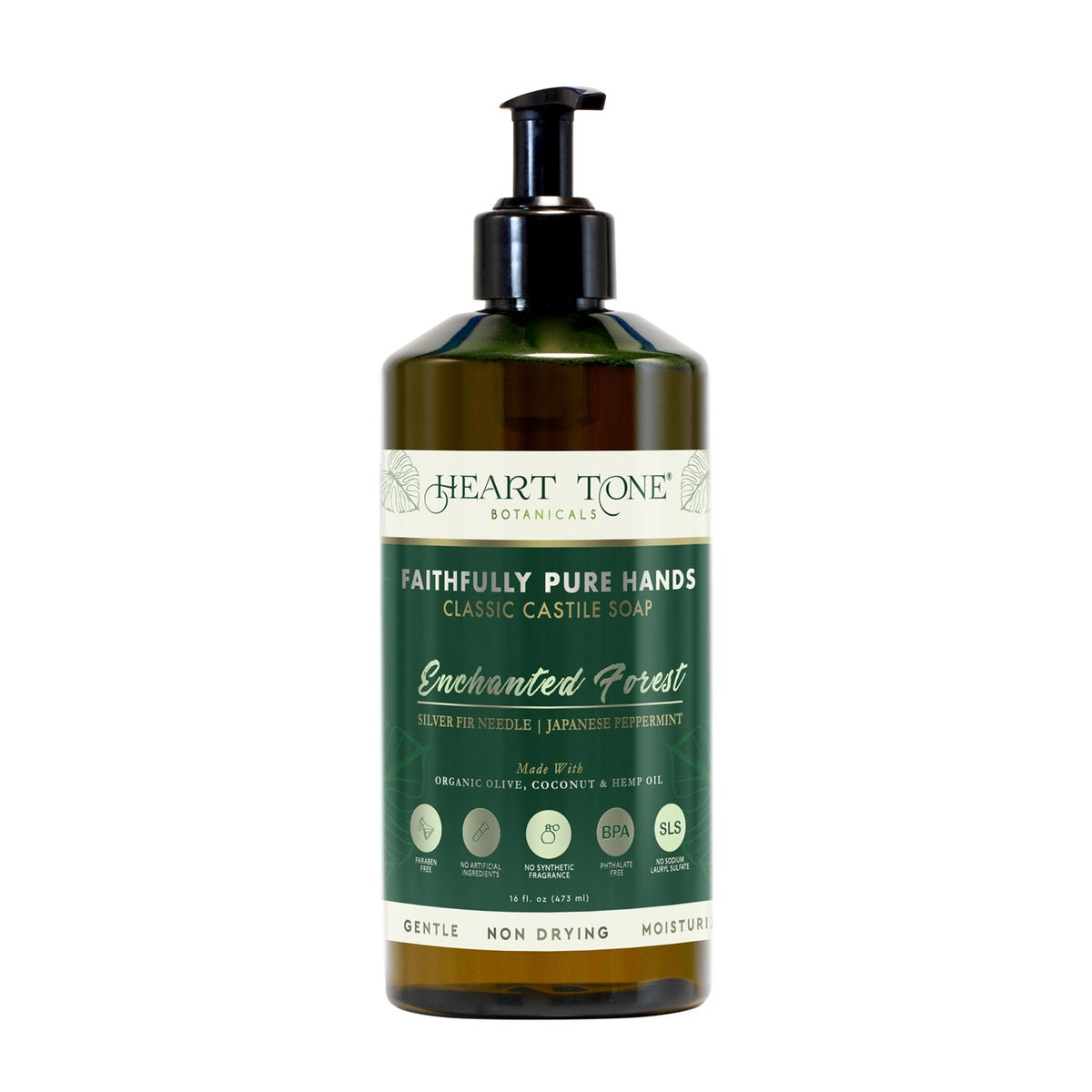
- Faithfully Pure Hands Castile Liquid Soap — available in four botanical scent profiles (Enchanted Forest, Florida Citrus, Pure Native, Wild Blossom), each built on the same traditional castile foundation with real essential oils and no artificial fragrance.
- Moroccan Exfoliating Black Soap — traditional beldi soap made with saponified olive oil and natural black olive paste. Includes a free Egyptian loofah sponge for the full traditional hammam experience.
- Ancient Organic Soaps — cold-processed bar soaps made with shea butter, coconut oil, and aloe vera. Three formulas: Aloe Fields, Alpha Bar, and Coconut Creme.
Pair any cleanser with the Botanical Renew Body Butter for a complete natural body care routine — cleanse, then seal in moisture with a plant-based butter that has no synthetic additives.
The Bottom Line
A natural body wash earns that description when the ingredient list backs it up: plant-derived surfactants, real botanical extracts, no synthetic sulfates or artificial fragrance, and a formula designed for daily use without leaving the skin feeling stripped.
The best formulas feel noticeably different — a gentle, comfortable lather that rinses clean and leaves your skin feeling balanced rather than tight. And many of them carry a long botanical tradition behind every ingredient, which is a kind of quality assurance that a label claim alone cannot replicate.
If you are ready to make the switch, explore our full natural body care collection — or start with the Herbal Castile Liquid Soap, one of the most versatile plant-based cleansers in the lineup.

Leave a comment
This site is protected by hCaptcha and the hCaptcha Privacy Policy and Terms of Service apply.