

The Hydroxyapatite Conversation in Natural Toothpaste
If you are following clean beauty and natural oral care trends in 2026, you have probably seen hydroxyapatite toothpaste everywhere. Hydroxyapatite is a calcium phosphate mineral found naturally in teeth and bones, which is why it has become such a popular ingredient in fluoride-free oral care.

But hydroxyapatite is not one single ingredient story. Particle size, particle shape, and source all matter. The three forms shoppers are most likely to see are nano-hydroxyapatite, micro-hydroxyapatite, and bovine-derived hydroxyapatite.
What Is Hydroxyapatite?
Hydroxyapatite is a mineral form of calcium phosphate. Tooth enamel is made largely of hydroxyapatite, which is why this ingredient feels intuitive to people looking for mineral-based, fluoride-free toothpaste.
In toothpaste, the practical question is not just "does it contain hydroxyapatite?" It is "what kind, what size, what shape, and what source?" Those details affect how a formula feels, how transparent the ingredient story is, and how comfortable a customer may feel using it every day.
Nano vs. Micro: The Particle Size Debate
A useful sizing reference comes from Fluidinova's public hydroxyapatite materials, which compare nano-HAp at about 50 nm, a specialty micro-HAp grade at about 1.1 µm, conventional micro-HAp at about 5 µm, and dentin tubules at about 2.5 µm. The important takeaway for shoppers is simple: the word "micro" is not specific enough by itself. A tightly specified micro grade can be very different from a conventional large-particle micro grade.
What Does µm Mean?
A micrometer, written as µm, is one millionth of a meter. Another way to read it: 1 µm equals 1,000 nanometers. That means a 50 nm nano-hydroxyapatite particle is about 0.05 µm, while Heart Tone's 1.1 µm micro-hydroxyapatite is about 1,100 nm, or roughly 22 times larger than that nano-HAp reference.
Let's talk about particle size
A quick scale for reading hydroxyapatite specs: 1 µm = 1,000 nm.
The 50 nm bar is kept visible for readability; at exact scale it would be almost a hairline next to the 5 µm reference.
This is the easiest way to understand Heart Tone's choice: our hydroxyapatite is in the micron-scale range at 1.1 µm / 1,100 nm. It is much larger than nano-HAp, but smaller than the dentin-tubule reference point often used in particle-size discussions. It lets customers compare the scale clearly without assuming that every "micro" hydroxyapatite ingredient is the same.
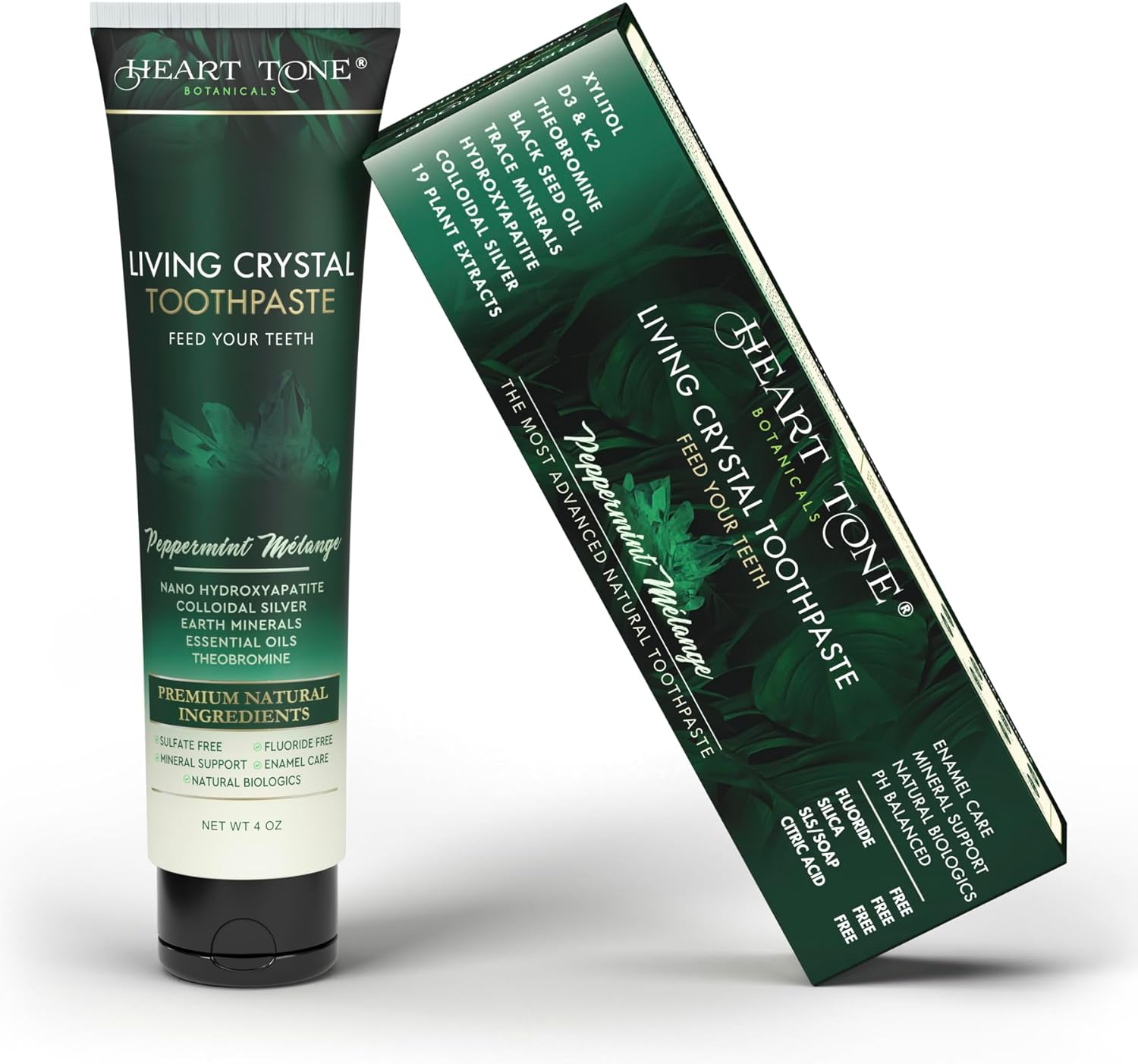
Heart Tone's Living Crystal Toothpaste uses a supplier-specified 1.1 µm spherical micro-hydroxyapatite. That size is smaller than the dentin tubule reference point of about 2.5 µm, while still being much larger than nano-HAp. In plain English, it sits in a precise middle ground: fine enough to be relevant to dentin-scale spaces, but not nanoparticle-scale.
For customers comparing clean oral-care formulas, that distinction matters. A 1.1 µm micro-HAp particle is small enough to make sense in a dentin-scale conversation, but it is not the same as a 50 nm nano-HAp particle. Heart Tone's approach is intentionally focused on a mineral-rich brushing experience at the tooth surface, without relying on nanoparticle-scale positioning.
That is why a good hydroxyapatite formula should be clear about particle size, source, and supplier controls instead of relying on the ingredient name alone.
Nano-Hydroxyapatite
Particle size: generally under 100 nanometers.
Nano-hydroxyapatite is the smallest form commonly discussed in toothpaste. Because the particles are extremely fine, it is often positioned around detailed enamel-surface coverage and comfort-focused brushing.
The main concern for some shoppers is the word nano itself. Even when a nano ingredient is allowed for oral care under specific conditions, clean-ingredient customers may still prefer to avoid nanoparticle-scale materials in a daily-use product.
Micro-Hydroxyapatite
Particle size: larger than nano, commonly discussed in the micrometer range.
Micro-hydroxyapatite is the larger-particle option. It fits customers who want a mineral-forward toothpaste without the same nanoparticle concern. In a daily brushing formula, micro-hydroxyapatite can be part of a smooth, polished, mineral-rich clean.
This is the direction Heart Tone Botanicals chose for Living Crystal Toothpaste: a fluoride-free formula built around 1.1 µm spherical micro-hydroxyapatite, theobromine, earth minerals, colloidal silver, and botanicals. Compared with a 2.5 µm dentin tubule reference, that particle size gives the formula a clear technical story without relying on nano-scale particles.
Where Bovine Hydroxyapatite Fits In
Bovine hydroxyapatite is hydroxyapatite sourced from cattle bone. It is usually discussed as a more "natural" or animal-derived mineral source, but it raises a different set of questions than synthetic or carefully specified mineral forms.
Particle size: bovine hydroxyapatite is commonly positioned as a larger-particle, non-nano material unless it has been further processed into a finer grade. That larger particle size can appeal to shoppers avoiding nano ingredients, but it also means the ingredient should not be treated as identical to nano-hydroxyapatite or a controlled spherical micro-hydroxyapatite grade.
Source transparency: because bovine hydroxyapatite begins as animal bone, sourcing and purification matter. A brand using it should be able to explain the animal source, processing controls, and contaminant testing. Without that documentation, customers may reasonably ask about potential unwanted impurities, including heavy metals or other source-related contaminants.
Customer fit: bovine hydroxyapatite may not work for vegan customers, customers avoiding animal-derived ingredients, or shoppers who want the most transparent mineral source possible. For those customers, a non-bovine, clearly specified micro-hydroxyapatite may feel like the cleaner choice.
How to Compare Hydroxyapatite Toothpastes
When reading a toothpaste label, look beyond the word hydroxyapatite and ask four practical questions:
- Particle size: is it nano, micro, or a broader non-nano grade?
- Particle shape: does the brand specify spherical, rod-shaped, needle-shaped, or unspecified particles?
- Source: is it synthetic, mineral-derived, marine-derived, or bovine-derived?
- Testing: does the brand discuss purity, heavy metals, or supplier controls?

Which One Should You Choose?
The answer depends on your priorities.
Choose nano-hydroxyapatite if:
- You are comfortable with nano-scale ingredients in oral care.
- You want the smallest particle size commonly used in hydroxyapatite toothpaste.
- You are comparing formulas that clearly document particle shape and safety specifications.
Choose micro-hydroxyapatite if:
- You prefer larger-particle minerals for daily brushing.
- You want to avoid nanoparticle-scale ingredients.
- You are looking for a mineral-rich toothpaste with a clean, polished mouthfeel.
Be cautious with bovine hydroxyapatite if:
- The brand does not explain where the bovine material comes from.
- There is no clear purity or contaminant-testing story.
- You avoid animal-derived ingredients for dietary, ethical, or religious reasons.
The Heart Tone Approach: 1.1 µm Micro-Hydroxyapatite + Botanicals
At Heart Tone Botanicals, we chose 1.1 µm spherical micro-hydroxyapatite for Living Crystal Toothpaste because it matches our philosophy: thoughtful minerals, farm-grown botanicals, and a fresh, premium brushing ritual.
That 1.1 µm specification matters. It is substantially larger than nano-HAp, which is often discussed around 50 nm, yet smaller than the average dentin tubule reference of about 2.5 µm. For shoppers comparing formulas, that makes our micro-HAp story more specific than simply saying "non-nano" or "micro."
Put another way: Living Crystal's hydroxyapatite is designed around a dentin-scale particle-size reference, not a nano-scale ingredient story. It gives shoppers a clear technical reason to understand why we chose this specific micro-HAp grade for a daily fluoride-free toothpaste.
Living Crystal Toothpaste is a fluoride-free formula featuring micro-hydroxyapatite, theobromine, colloidal silver, earth minerals, and botanicals in a smooth mint paste designed to leave the mouth feeling clean, fresh, and polished.
The Bottom Line
Nano, micro, and bovine hydroxyapatite are not interchangeable. Nano is about extremely small particle size. Micro can range widely, from a precise 1.1 µm specialty grade to larger conventional micro grades. Bovine hydroxyapatite adds a source question: animal-derived material, often larger particle size, and a need for strong purity documentation.
For shoppers who want a fluoride-free toothpaste without nano-scale or bovine-source concerns, Living Crystal Toothpaste offers a mineral-forward daily ritual built around spherical micro-hydroxyapatite and botanicals.

Leave a comment
This site is protected by hCaptcha and the hCaptcha Privacy Policy and Terms of Service apply.