












The Short Answer: Less Often Than the Trend Suggests

Activated charcoal shows up in toothpaste, powders, and DIY dips all over social media, and the appeal is obvious — a fast, dramatic before-and-after from an ingredient that sounds simple and natural. But the question that actually matters isn't whether charcoal "works." It's how often you can use it without causing a problem you can't undo. That question deserves a straight answer, because with charcoal, frequency is the whole story.
Most dental guidance lands in the same range: no more than once or twice a week, and some dentists recommend even less — once every other week — regardless of how your teeth feel in the moment. The American Dental Association has not extended its Seal of Acceptance to any charcoal brightening product, and daily or every-other-day use is where people run into trouble.
Why Frequency Is the Whole Question With Charcoal
Activated charcoal doesn't dissolve or lift stains chemically. It works mechanically — a gritty powder that physically scrubs the tooth surface. That's exactly why how often you use it matters so much more than with a typical toothpaste: an abrasive ingredient's effect on enamel scales directly with how often and how hard it's applied, not with how long you've owned the jar.
Enamel is the hardest substance in the human body, but unlike skin or hair, it does not grow back once it's gone. Once it's mechanically worn down through repeated abrasive brushing, that layer is permanent — there's no cycle that replaces it. Used sparingly, an abrasive polish is a normal part of oral care — most toothpaste has some level of abrasivity built in, which is the same RDA abrasivity-rating logic behind how low-abrasion toothpaste is scored for enamel safety. Used daily, especially with a wet powder and a hard-bristled brush, the same mechanical action adds up fast.

What Overuse Looks Like
- A sharp, new twinge from cold drinks or cold air — a common signal enamel has thinned
- A duller appearance over time, not a brighter one — as enamel wears thin, the yellower dentin layer underneath becomes more visible, which can undo the exact result someone was chasing
- Rough or uneven-feeling tooth surfaces — a sign the polish is outpacing what enamel can comfortably handle
- Gums that feel scraped or tender — common with a wet powder applied under too much pressure
Does the Format Change the Math?
Charcoal shows up in a few different forms, and they are not interchangeable when it comes to frequency. Loose charcoal powder mixed into a paste tends to be the coarsest and hardest to control — it's easy to use too much or press too hard when you can't see exactly what's in the mix. A charcoal-infused toothpaste with a finer, more consistent grind is generally milder, but "milder" doesn't mean "daily-safe" — it just means the weekly cap has more room in it before you notice a problem. Charcoal floss and charcoal-coated picks work on a different surface (between teeth, not the enamel face) and carry a lower brightening claim to begin with, so they're a separate category from a brushing product entirely.
The label on a charcoal product marketed for "daily use" is worth reading skeptically. A once-or-twice-a-week cap reflects a mechanical reality — how much abrasive contact enamel can absorb before it wears — not a marketing decision, and that reality doesn't change just because a package says otherwise.
How to Use It More Carefully, If You're Going to Use It
- Cap it at once or twice a week — not as a daily swap for your regular toothpaste
- Use a soft-bristled brush and let the charcoal do the work; pressing harder doesn't speed anything up, it just increases the abrasive contact
- Keep sessions short, under two minutes, rather than an extended scrub
- Watch for that cold twinge and stop the moment it shows up
- Skip it entirely if you have exposed dentin, receding gum lines, or another abrasive polish planned the same week
Who Should Skip It Altogether
Some situations aren't about frequency at all — they're a reason to leave charcoal out of the routine entirely. Anyone with dental crowns, veneers, bonding, or fillings on front teeth should be cautious, since charcoal's abrasive action affects those surfaces differently than natural enamel and can dull or scratch them in ways that aren't reversible with a cleaning. The same goes for braces or other orthodontic hardware, where a gritty paste can work its way into brackets and wires. And for kids, a weekly abrasive polish is generally more than a developing mouth needs — a gentler daily formula is the simpler call there too.
A Gentler Everyday Alternative
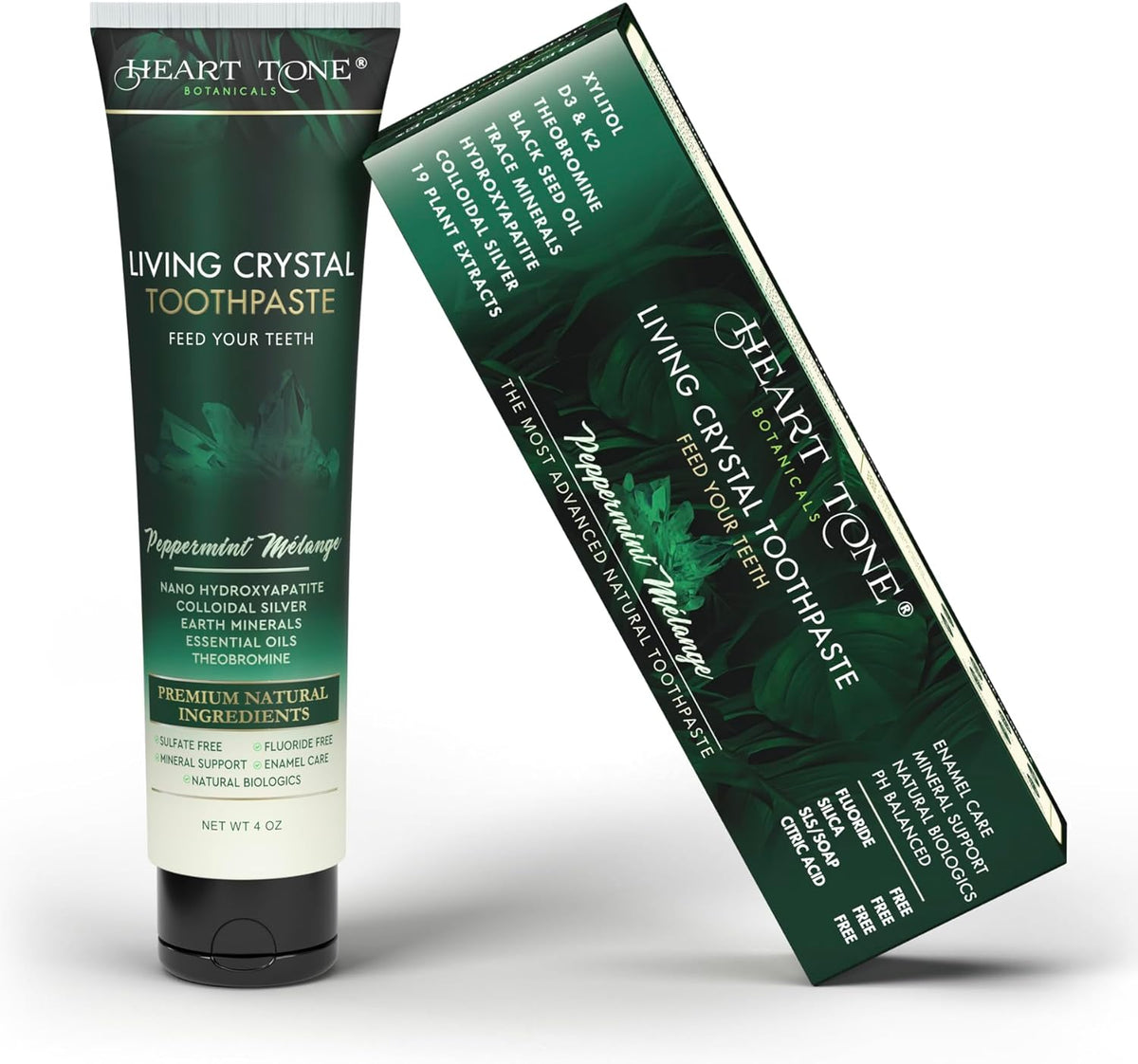
For a daily toothpaste that doesn't come with a weekly countdown, a lower-abrasivity, clay-based formula is worth a look. Heart Tone's Living Crystal Toothpaste is built around kaolin and bentonite clay along with micro-hydroxyapatite — a fine, traditional polishing base rather than a high-grit powder — so it's formulated for everyday use rather than an occasional, higher-risk approach. It's fluoride-free, made without SLS, and contains no charcoal grit, in a formula built with 30+ farm-grown botanical extracts.
Pair it with our Restorative Mouth Rinse, an alcohol-free rinse built on colloidal silver, farm-grown aloe vera, and a full botanical extract blend, to round out a daily routine that doesn't lean on an abrasive weekly reset.
The Bottom Line
Charcoal teeth brightening isn't automatically off the table — but it belongs on a once-or-twice-a-week cadence, not a daily habit, and the moment a cold twinge or rough patch shows up, that's a sign to back off. If tracking a weekly schedule isn't appealing, a gentler, clay-based daily formula is the simpler long-term approach.
Explore the full natural oral care collection from Heart Tone Botanicals to build a daily routine that doesn't depend on an abrasive weekly reset.

Leave a comment
This site is protected by hCaptcha and the hCaptcha Privacy Policy and Terms of Service apply.