












Walk down any hair care aisle and you'll see "silicone-free" on more labels than ever. But what does it actually mean — and should it matter to you? If you've been using conventional conditioners for years and your hair seems fine, it's fair to question whether this is just another marketing trend.
The honest answer: it depends on your hair type, your goals, and what else is in your routine. But if you're chasing long-term hair health over short-term shine, understanding silicones is worth your time.
What Are Silicones, Exactly?

Silicones are a family of synthetic compounds derived from silicon, oxygen, and various organic groups. In hair care, they're used as conditioning agents — they coat the hair shaft with a smooth, water-repellent film that makes strands feel instantly silky and look glossy.
Common silicones you'll find on ingredient labels include:
- Dimethicone — one of the heaviest, most coating silicones
- Cyclomethicone / Cyclopentasiloxane — lighter, evaporates more quickly
- Amodimethicone — bonds to damaged areas of the hair; generally considered gentler
- Phenyl trimethicone — adds shine and heat protection
The key thing to know: most silicones are not water-soluble. That means water alone won't rinse them off. Over time — and especially if you're washing with sulfate-free or gentle shampoos — silicones can accumulate on the hair shaft and scalp, creating a barrier that looks like "buildup" or "product buildup."
The Buildup Problem
Here's where silicones get complicated. That coating that makes your hair feel silky? It also sits between your hair and everything you're trying to put into it — moisture, plant actives, protein treatments, and conditioning agents.
For people with fine or straight hair, this can manifest as limpness and loss of volume. For curly or coily hair types, the barrier effect can be more pronounced: curls that once bounced start to fall flat, dryness creeps in despite regular conditioning, and products seem to stop working the way they used to.
This is sometimes called the "silicone cycle" — you use a silicone conditioner, hair feels great immediately, but over weeks the coating accumulates. Hair gets heavier, moisture can't penetrate, and the only fix is a clarifying wash that strips everything out so you can start again.
If this pattern sounds familiar — your hair feels great the day you wash it, but progressively dull or dry as the week goes on — silicone buildup may be part of what's happening.
What a Silicone-Free Conditioner Does Differently
A silicone-free conditioner skips the synthetic coating and instead relies on plant-derived emollients, botanical butters, and natural oils to condition the hair. These ingredients work with the hair's existing structure rather than coating over it.
The practical difference:
- No cumulative buildup — plant oils and butters don't create the same insoluble film
- Better moisture access — without a silicone barrier, moisture-binding ingredients can actually reach the cortex
- More natural texture — curls and waves can express their true pattern instead of being weighed down
- Scalp friendliness — silicone residue near the scalp can contribute to itchiness or clogged follicles; natural alternatives are generally gentler
The tradeoff, honestly, is that silicone-free conditioners may feel less immediately "slippy" during application. Silicones are genuinely good at reducing friction while you detangle. The transition period — the first few weeks after switching — can feel like a downgrade. That's usually just your hair adjusting. Once the old silicone coating clears, most people find their hair responds better to conditioning ingredients than it did before.
Who Benefits Most from Silicone-Free Hair Care
Not everyone needs to go silicone-free. But certain hair types and situations tend to benefit the most:
Curly and Coily Hair
Textured hair is naturally more porous and prone to dryness. The curl pattern means scalp oils don't travel down the shaft as easily as they do on straight hair, so moisture retention is already a challenge. Adding a silicone barrier on top makes the problem worse. Silicone-free formulas let botanical conditioners and oils do their job without interference.
Low Porosity Hair
Low porosity hair already has tightly bound cuticles that resist absorbing moisture. Layer silicones on top of that and you've essentially sealed a door that was already difficult to open. Silicone-free conditioners, especially lighter ones, give moisture a better chance of getting in.
Fine or Thin Hair
Silicones are heavy by nature. Fine hair gets weighed down easily, leading to flat, limp strands even right after washing. Switching to silicone-free formulas often restores volume and movement that was being suppressed.
Anyone Chasing Long-Term Hair Health
If your goal is stronger, longer, healthier hair — not just a temporary gloss — silicone-free is worth considering. You're building hair health, not just managing its appearance.
What to Look For in a Silicone-Free Conditioner
Going silicone-free doesn't mean settling for an inferior product. The best natural conditioners replace silicones with ingredients that offer genuine nourishment:
- Plant butters (shea, kokum, cupuaçu) — rich emollients that soften and seal the cuticle naturally
- Botanical oils (argan, jojoba, moringa, marula) — penetrate the hair shaft rather than just coating it
- Humectants (aloe vera, panthenol, glycerin) — draw and hold moisture from the environment into the hair
- Plant-derived proteins (oat, rice, wheat) — strengthen the hair structure without synthetic coating
- Scalp-active botanicals — ingredients that support follicle health, not just strand appearance
What you don't want to see: dimethicone, cyclomethicone, amodimethicone, trimethicone, or any ingredient ending in "-siloxane" or "-cone" if you're going fully silicone-free.
How to Transition to Silicone-Free Hair Care
If you've been using silicone-based products, the transition requires one clarifying step first. Use a clarifying shampoo (or a shampoo with a mild sulfate like sodium lauryl sulfate) once to strip the accumulated silicone coating. After that, you're starting with a clean slate.
From there:
- Switch to a silicone-free shampoo and conditioner
- Expect a 2–4 week adjustment period where hair may feel different than before
- Focus on moisture: seal it in with a leave-in or oil after conditioning
- Be patient — the payoff is hair that actually absorbs what you're giving it
Once the transition is complete, most people find they don't need to clarify nearly as often because there's no silicone buildup to clear.
What We Use at Heart Tone Botanicals
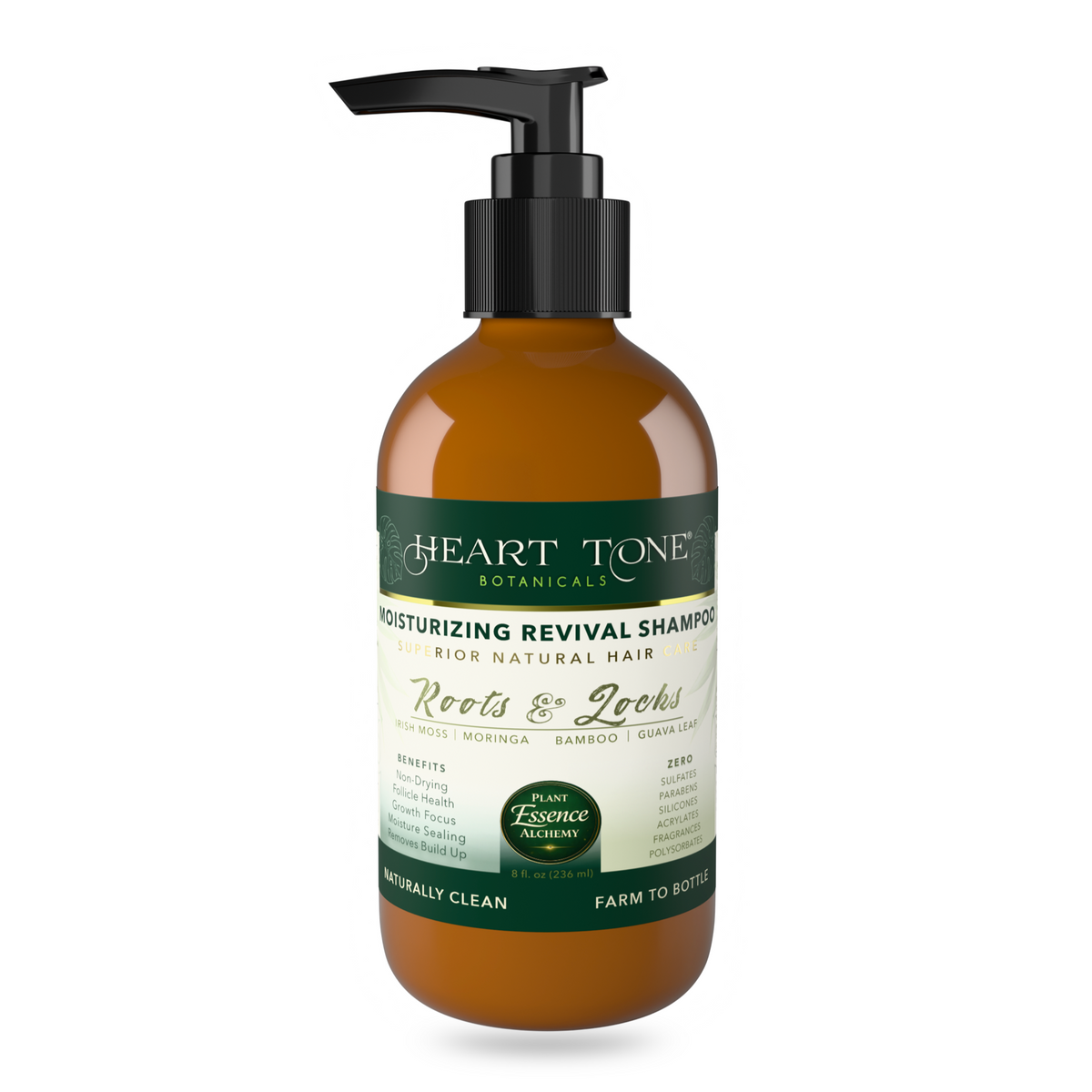
Our Roots & Locks Moisturizing Revival Conditioner is built entirely on botanical conditioning agents — no silicones, no synthetic coating agents. The formula uses rare botanical plants grown beyond organically on JD's farm in Vero Beach, Florida, hand harvested and carefully extracted to preserve their active plant compounds.
What you get instead of silicones: rich botanical butters and oils that coat each strand with a deep conditioning layer, plant-derived humectants that pull moisture in, and scalp-active botanicals that work at the follicle level — not just on the surface.
Paired with our Roots & Locks Moisturizing Revival Shampoo — also completely silicone-free — you have a full wash day routine that nourishes without the buildup cycle. The shampoo cleanses deeply while preserving the scalp microbiome; the conditioner restores, seals, and softens without layering synthetic coating on top.
Both are color-safe, suitable for all hair types, and formulated with the same farm-to-bottle philosophy that shapes everything we make.
→ Explore our full Hair Care collection
The Bottom Line
Silicone-free conditioner isn't a gimmick — it's a different philosophy about what conditioning actually means. Silicones offer a quick, cosmetic fix: smooth, shiny, manageable hair right after washing. But for people whose hair needs real moisture, better texture, or long-term resilience, the silicone coating gets in the way.
Switching to a silicone-free formula, especially one built on botanical actives, lets your hair actually absorb what you're putting on it. The adjustment takes a few weeks. The results tend to be worth it.
If you're ready to try it, our hair care collection is a good place to start — everything formulated clean, without the compromises.

Leave a comment
This site is protected by hCaptcha and the hCaptcha Privacy Policy and Terms of Service apply.