












If you've ever winced at a cold drink or noticed a sharp, reactive sensation mid-brush, you're already familiar with what it feels like to have teeth that seem more easily triggered than they used to. For a lot of people, that experience leads to one place: the toothpaste aisle, reading labels.
What's actually in here? Is something in this formula making things worse?
Those are reasonable questions — and the answers, when you look at conventional formulas, are worth understanding.
What Conventional Formulas Often Contain

Many conventional toothpastes include ingredients that label-conscious buyers have started paying closer attention to — not because they're universally harmful, but because some people prefer to avoid them or find them uncomfortable.
Sodium Lauryl Sulfate (SLS)
SLS is a synthetic detergent and foaming agent found in a wide range of personal care products. It's what creates the aggressive foam that many conventional toothpastes are known for. Some people with more reactive teeth prefer SLS-free formulas because synthetic foaming agents can create a harsher feel during brushing. Natural alternatives foam less — but for many people, that's exactly what they're looking for.
Synthetic Abrasives
Abrasivity in toothpaste is measured by a standard called the Relative Dentin Abrasivity (RDA) scale — a number that doesn't appear on any label. Formulas that market themselves aggressively on brightening or stain removal often rely on more aggressive abrasive compounds. Natural formulas tend to use finer-textured mineral-based cleaning agents instead.
Artificial Sweeteners and Synthetic Flavoring
Saccharin and other synthetic sweeteners appear in many conventional formulas. Plant-derived sweeteners — like xylitol and organic stevia — are what you'll find in botanical alternatives. The flavor profile tends to be noticeably different: cleaner, cooler, and without the lingering artificial taste that some people find off-putting.
What to Look For in a Natural Formula
There's no single ingredient list that works for everyone — but a few categories are worth understanding when you're reading labels.
Abrasive Type and Texture
Natural toothpastes typically use mineral-based cleaning agents. Kaolin clay has a fine, soft texture — it's a gentle cleaning mineral with a long history of use in personal care. Bentonite clay is another option with a smooth, fine-particle feel. Neither is aggressive in texture the way some synthetic abrasive compounds can be.
Plant-Derived Sweeteners
Xylitol is a naturally derived sweetener found in birch bark and some fruits. It has a long history of use in botanical oral care formulations and contributes a clean, pleasant taste without the artificial finish of synthetic sweeteners. Organic stevia is another plant-derived option commonly found in natural formulas.
Botanical Extracts with Traditional Roots
Ingredients like myrrh, licorice root, rhatany root, and usnea lichen have been used in botanical oral care traditions for centuries. You'll find them listed as CO2 extracts in many natural toothpastes. They contribute to the flavor, character, and feel of the formula — and understanding their traditional context can help you make sense of a longer ingredient list.
Absence Claims Worth Noting
Look for: fluoride-free, SLS-free, alcohol-free, no artificial sweeteners. These absence claims are meaningful — they tell you what you won't encounter during brushing. For people who prefer a gentler daily routine, these exclusions matter as much as what's included.
Living Crystal Toothpaste
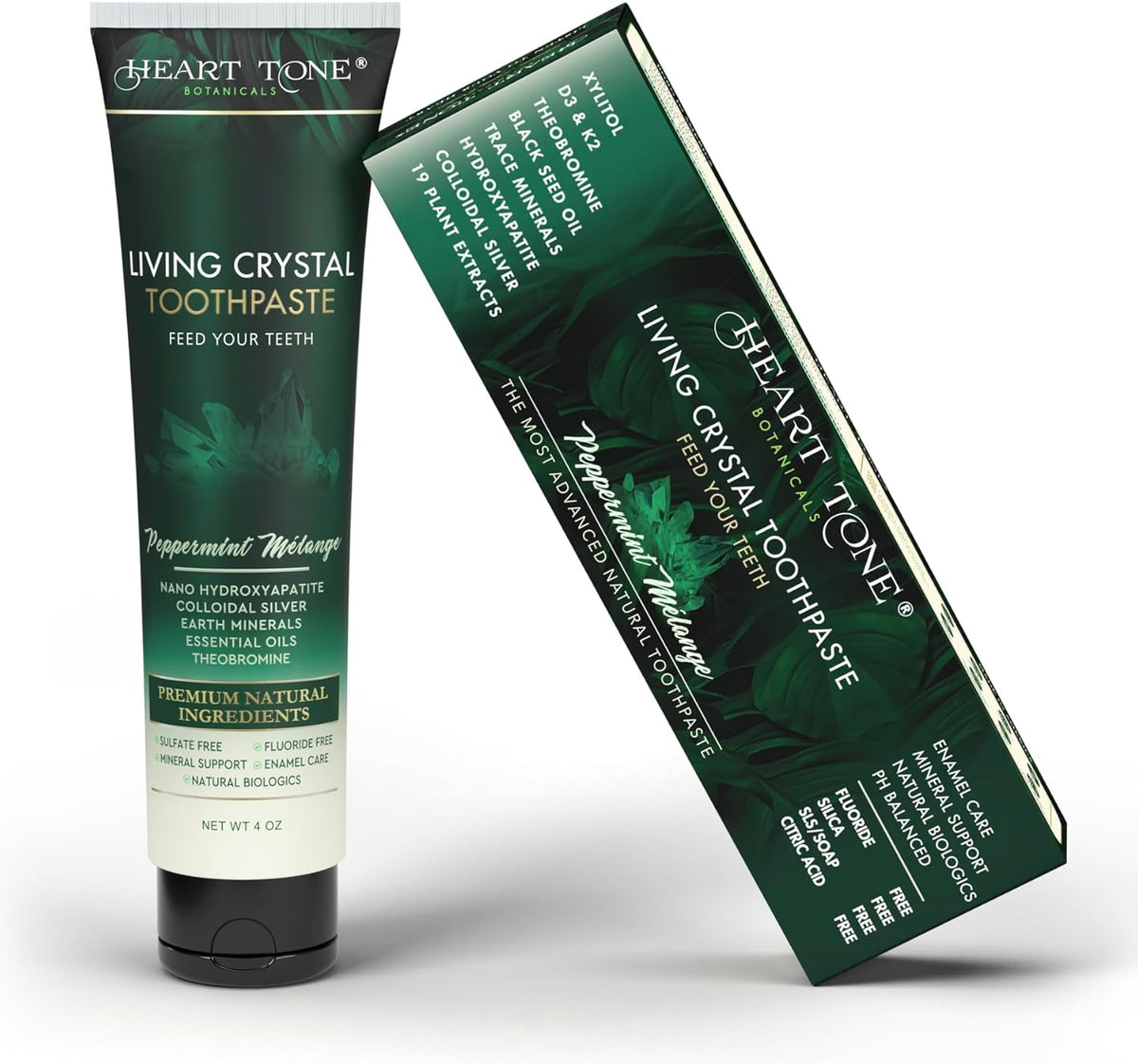
Living Crystal Toothpaste is Heart Tone Botanicals' fluoride-free, SLS-free, alcohol-free toothpaste. The formula was designed around a botanical philosophy rather than a conventional brightening or tartar-control approach.
The cleaning base uses kaolin clay and bentonite clay — both fine-textured mineral options. Spherical micro-hydroxyapatite is included as a mineral-form ingredient. Organic xylitol and organic stevia are the sweetening components.
The botanical portion of the formula includes organic myrrh co2, rhatany root co2, licorice root co2, usnea lichen co2, organic clove co2, organic calendula flower co2, organic raspberry seed, black cumin oil, and yucca schidigera — a list that reflects a traditional botanical approach to oral care.
Additional ingredients include colloidal silver, zeolite clinoptilolite, zinc citrate, L-arginine, vitamin D-3, and vitamin K-2, along with organic coconut oil and organic vegetable glycerin as the base carriers.
The flavor comes from a layered mint blend — peppermint oil, spearmint oil, cornmint oil, wintergreen oil, organic menthol, and organic cinnamon bark — leaving a cool, clean finish that feels noticeably different from conventional foam-heavy formulas.
No fluoride. No SLS. No artificial sweeteners. No synthetic flavoring.
Explore Living Crystal Toothpaste →
What About the Rinse?
If you're rethinking your toothpaste, it's worth looking at your mouthwash at the same time. Many conventional rinses use alcohol as a primary ingredient — which creates a harsh, burning sensation and can leave the mouth feeling dry. For people who already notice discomfort during brushing, that kind of rinse can compound the problem.
Restorative Mouth Rinse is alcohol-free. It's built on colloidal silver, aloe vera leaf juice, colloidal zinc, and xylitol, with a blend of botanical extracts: peppermint, cornmint, spearmint, wintergreen, organic menthol crystals, licorice root co2, myrrh co2, rhatany root, tea tree oil, turmeric co2, mace co2, clove bud co2, thyme co2, and oregano co2. No alcohol. No synthetic antiseptics. No burning.
The finish is clean and cool — a noticeably gentler experience than conventional alcohol-based rinses.
Explore Restorative Mouth Rinse →
The Full Oral Care Collection
Looking to explore everything in the botanical oral care lineup? The HTB Oral Care Collection includes Living Crystal Toothpaste, Restorative Mouth Rinse, the Antioxidant Oil Pull, the Ozonated Oil Pull, and a bamboo toothbrush — a complete botanical routine from start to finish.

Leave a comment
This site is protected by hCaptcha and the hCaptcha Privacy Policy and Terms of Service apply.