












Most Natural Mouthwash Labels Don't Tell You Much — Here's How to Read One That Does

The term "natural mouthwash" doesn't mean a lot by itself. Any brand can print it on a bottle. What actually separates a thoughtful botanical formula from a bottle of flavored water is what's in the ingredient list — and in what order those ingredients appear. If you've been trying to find a natural mouthwash that feels like it's doing something, this guide is about understanding the formula: what the ingredients are, where they come from, and what they contribute to the daily rinse experience.

A mouthwash formula — natural or otherwise — is built in layers. The base carries the ingredients. The botanical core delivers the rinse experience. The finishing ingredients shape how the formula feels and how long the fresh sensation lasts. A serious botanical formula addresses all three layers.
The Base: What Carries the Formula
Most mouthwashes — conventional and natural alike — use water as their primary carrier. A well-formulated natural mouthwash also includes something to help stabilize and disperse the botanical ingredients, since essential oils and plant extracts don't naturally distribute evenly in water without a bit of help.
Two plant-derived stabilizers worth knowing:
Yucca Schidigera
Yucca schidigera extract is derived from the yucca plant, a desert succulent with a long history of traditional use in personal care. In a mouthwash formula, yucca extract helps distribute essential oils and botanical extracts evenly throughout the rinse, so every swish delivers a consistent experience. It also contributes a gentle, slightly foamy quality that feels cleansing without synthetic surfactants.
Quillaja Saponaria (Soapbark)
Quillaja saponaria, also known as soapbark, is a South American tree bark extract that has been used in natural personal care formulations for generations. Like yucca, it acts as a gentle, plant-derived dispersant — helping essential oils and botanical extracts remain uniformly distributed in a water-based formula throughout the life of the bottle.
The Botanical Core: What Creates the Rinse Experience
Colloidal Silver
Colloidal silver has been used in traditional oral care for centuries. It's valued for its gentle, non-drying character and its long history as a traditional personal care ingredient. Unlike alcohol, which creates an intense burning sensation and leaves the mouth feeling dry, colloidal silver contributes to a clean, comfortable rinse experience that doesn't disrupt the natural moisture balance of the mouth.
Aloe Vera Leaf Juice
Farm-grown aloe vera is one of the most widely used botanical ingredients in traditional oral care. In a mouthwash formula, aloe vera leaf juice helps create a soothing, non-drying base that feels comfortable during rinsing. It's particularly valued in alcohol-free formulations where the goal is a gentle daily rinse experience rather than a sharp, astringent one.
Xylitol
Xylitol is a naturally derived sugar alcohol with a long history of use in oral care products. Sourced from plant material — typically birch or corn — it contributes a mild, pleasant sweetness to a mouthwash formula without being an actual sugar. In a natural mouthwash, xylitol contributes to the overall palate experience and the sensation of clean freshness after rinsing.

The Mint Complex: What Drives the Freshness Sensation
In a serious botanical mouthwash, mint isn't a single ingredient — it's a layered blend. Peppermint, cornmint, spearmint, and wintergreen each contribute different aspects of the mint experience: the initial crisp coolness, the depth of the menthol note, and the lingering freshness that stays with you after rinsing.
- Peppermint essential oil — one of the most widely used botanicals in traditional oral care, delivering the signature fresh, cooling mint sensation
- Cornmint (mentha arvensis) — a rich source of natural menthol, contributing depth and staying power to the fresh sensation
- Spearmint essential oil — softer and slightly sweeter than peppermint, adding a rounded note to the mint profile
- Wintergreen essential oil — contributes a distinctive warming-cooling contrast and a longer-lasting botanical freshness
- Organic menthol crystals — concentrated plant-derived menthol for a distinct, clean finish to the rinse
A layered mint blend like this creates a sensory profile that is noticeably different from synthetic mint flavoring — more complex, with more dimension, and a longer-lasting sensation.
The Traditional Botanical Depth: What Gives a Formula Character
Myrrh
Myrrh resin has been a staple of traditional oral care since antiquity — one of the oldest recorded botanical ingredients in personal care traditions around the world. Valued for its distinctive warm, slightly earthy character, myrrh extract contributes to a long-lasting sensation of botanical freshness that sits underneath the mint complex in a finished rinse.
Licorice Root
Licorice root (glycyrrhiza glabra) has a centuries-long history of use in traditional oral care across Asian and European botanical traditions. Its naturally sweet, slightly anise-like character adds a finishing note to the rinse that rounds out the mint and contributes to a balanced, complete sensory experience.
Rhatany Root
Rhatany root (krameria lappacea) is a South American plant with a long history of use in traditional European herbal oral care. It contributes a mild astringent quality to the rinse sensation and has been a component of traditional botanical tooth and mouth formulations for over two centuries.
Clove, Thyme, Turmeric, Oregano, and Mace — The Deep Botanical Layer
A truly comprehensive botanical mouthwash formula often includes a deeper layer of traditional extracts: clove bud, thyme, turmeric, oregano, and mace. These botanicals have long histories of use in herbal and Ayurvedic oral care traditions. Each contributes to the complexity and depth of the overall formula — giving a serious botanical rinse a character and finish that simpler single-note formulas cannot replicate.
What a Thin Formula Looks Like by Comparison
A large portion of products marketed as "natural mouthwash" are built around water, glycerin, and a single drop of peppermint oil — with perhaps a preservative or two. On the label, that looks like: water, glycerin, polysorbate 20, peppermint flavor. The result is a mouthwash that tastes slightly minty for about thirty seconds and then leaves nothing behind.
A botanical formula built from the ground up — with a real mint complex, traditional botanical extracts, plant-derived dispersants, and a non-drying base — delivers a noticeably different rinse experience. The freshness is more complete, the character is richer, and the sensation lasts longer than what a thin formula can offer.
What to Skip When Reading the Label
If your goal is a genuinely natural mouthwash, a few common ingredients are worth avoiding:
- Ethanol (alcohol) — can leave the mouth feeling dry with repeated daily use; not ideal for an everyday rinse
- Fluoride — added to conventional mouthwashes as an OTC drug ingredient; not what you're looking for in a botanical formula
- Artificial sweeteners (saccharin, aspartame) — commonly used as inexpensive flavoring in conventional formulas
- Synthetic preservatives (methylparaben, propylparaben) — not needed in a properly formulated natural rinse
- Artificial colors or dyes — no functional purpose in an oral care formula; typically added only for aesthetics
The Bottom Line
Reading a natural mouthwash ingredient list is the fastest way to tell if a formula is serious or superficial. Look for a real botanical base — yucca, soapbark, or similar plant-derived dispersants. Look for a genuine mint complex drawn from multiple mint sources. Look for traditional botanicals with documented history in oral care traditions: myrrh, licorice root, rhatany, clove. And look for what the formula leaves out — no alcohol, no fluoride, no artificial sweeteners, no synthetic preservatives.
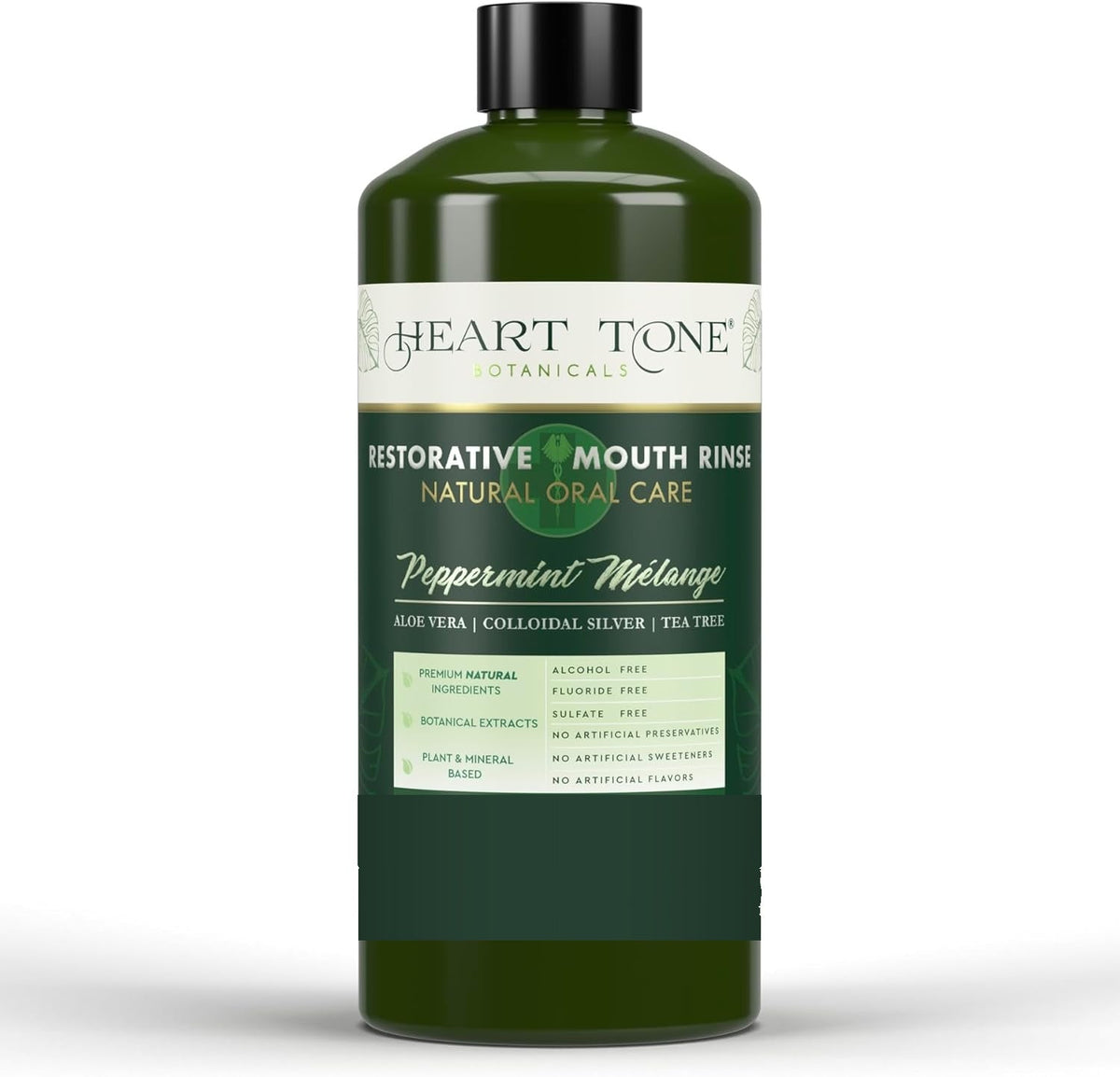
The Restorative Mouth Rinse from Heart Tone Botanicals is built on 22 botanical ingredients — colloidal silver, farm-grown aloe vera, a five-part mint complex, and a deep layer of traditional botanical extracts including myrrh, licorice root, rhatany, clove, and thyme. No alcohol. No fluoride. No synthetic additives. Browse our full natural oral care collection to see the complete daily ritual.
Pairing your mouthwash with a botanical toothpaste? Living Crystal Toothpaste rounds out the daily oral care routine — fluoride-free, SLS-free, and built with 30+ botanical extracts.

Leave a comment
This site is protected by hCaptcha and the hCaptcha Privacy Policy and Terms of Service apply.