












The Short Answer: What You Put On Your Skin Matters as Much as What You Take Off

Dry skin isn't just a winter problem. For a lot of people, it shows up year-round — that tight feeling after a shower, rough patches on elbows and shins, skin that looks dull no matter how much water you drink. A thoughtful natural body care routine can change how your skin looks and feels, not because of one miracle ingredient, but because of how the full routine works together.
The right sequence matters: how you cleanse, when you exfoliate, and how quickly you lock in moisture after bathing each play a role. Getting all three right is what separates a routine that actually works from one that just adds products.
Step One: Cleanse Without Stripping
Most conventional body washes rely on sulfates and synthetic detergents — they produce an impressive lather, but they can leave skin feeling tight and uncomfortable after rinsing. For people who already experience dry skin, that sensation is often more pronounced.
The traditional alternative is castile soap. True castile soap is made by saponifying plant oils — olive oil, coconut oil, jojoba, hemp — with no synthetic detergents or additives. The result is a lather that feels genuinely clean without leaving skin feeling stripped or dry to the touch.
Herbal Castile Liquid Soap from Heart Tone Botanicals is made with certified organic olive oil, coconut oil, sunflower oil, hemp oil, and jojoba oil — all cold-processed together with no synthetic surfactants. It's a formula with deep roots in traditional botanical cleansing, available in multiple scent options for different preferences.
For those who prefer a bar format, the Ancient Organic Soaps use the same organic oil base — coconut, olive, hemp, jojoba, and sunflower — cold-processed with no synthetic additives. The Coconut Creme variety adds real coconut milk and coconut pulp to the formula for a noticeably creamy, rich lather that rinses cleanly.
If you're sensitive to fragrance, the Faithfully Pure Castile Liquid Soap Pure Native is completely unscented — one of the few truly fragrance-free options in a traditional castile formula.
Step Two: Exfoliate Gently (Not Aggressively)
Dry skin tends to accumulate a rough, uneven surface layer — especially on shins, upper arms, and elbows. Gentle, regular exfoliation helps your moisturizer absorb more effectively and leaves skin looking and feeling visibly smoother. The key word is gentle: aggressive scrubbing with coarse materials can leave skin feeling worse, not better.
Two tools with long traditions in botanical body care:
Moroccan Black Soap
Savon Beldi — Moroccan black soap — is a traditional North African preparation that has been used in hammam (bathhouse) rituals for centuries as a pre-exfoliation treatment. It's made from olive oil and aged olive paste and leaves skin feeling remarkably soft and refreshed. The ritual involves applying it to damp skin, letting it sit briefly, then working it in and rinsing — either with hands or with a kessa mitt or loofah.
Moroccan Exfoliating Black Soap from Heart Tone Botanicals is made from organic olive oil and aged Moroccan black olive paste — a simple, two-ingredient traditional formula with no additives. It comes bundled with an Egyptian Loofah Sponge for a complete traditional exfoliation experience.
Egyptian Loofah
The Luffa aegyptiaca plant has been cultivated for centuries for its naturally fibrous, exfoliating texture. Unlike synthetic scrubbers, a natural loofah provides a gentle, graduated exfoliation that leaves skin looking visibly more even without roughness or irritation. Heart Tone's Premium Egyptian Loofah Sponge is grown on their regenerative farm in Vero Beach, Florida, without pesticides or synthetic inputs — one of the few truly farm-grown personal care tools in their lineup.
Once or twice a week is typically enough for most people. The goal is a smoother, more even surface that holds moisture better, not daily scrubbing.
Step Three: Moisturize While Your Skin Is Still Damp
The most important timing detail in a dry skin routine is this: apply your moisturizer before your skin has fully dried after bathing. That brief window — while skin is still slightly damp — is when a richer formula absorbs most readily and leaves the longest-lasting feeling of comfort and softness.
For genuinely dry skin, a body butter tends to outperform a thinner lotion. The difference is in the base: body butters use a higher ratio of plant butters — shea, kokum, mango — which create a richer, longer-lasting sensation than water-based lotions. They feel denser going on but absorb into a silky, non-greasy finish.
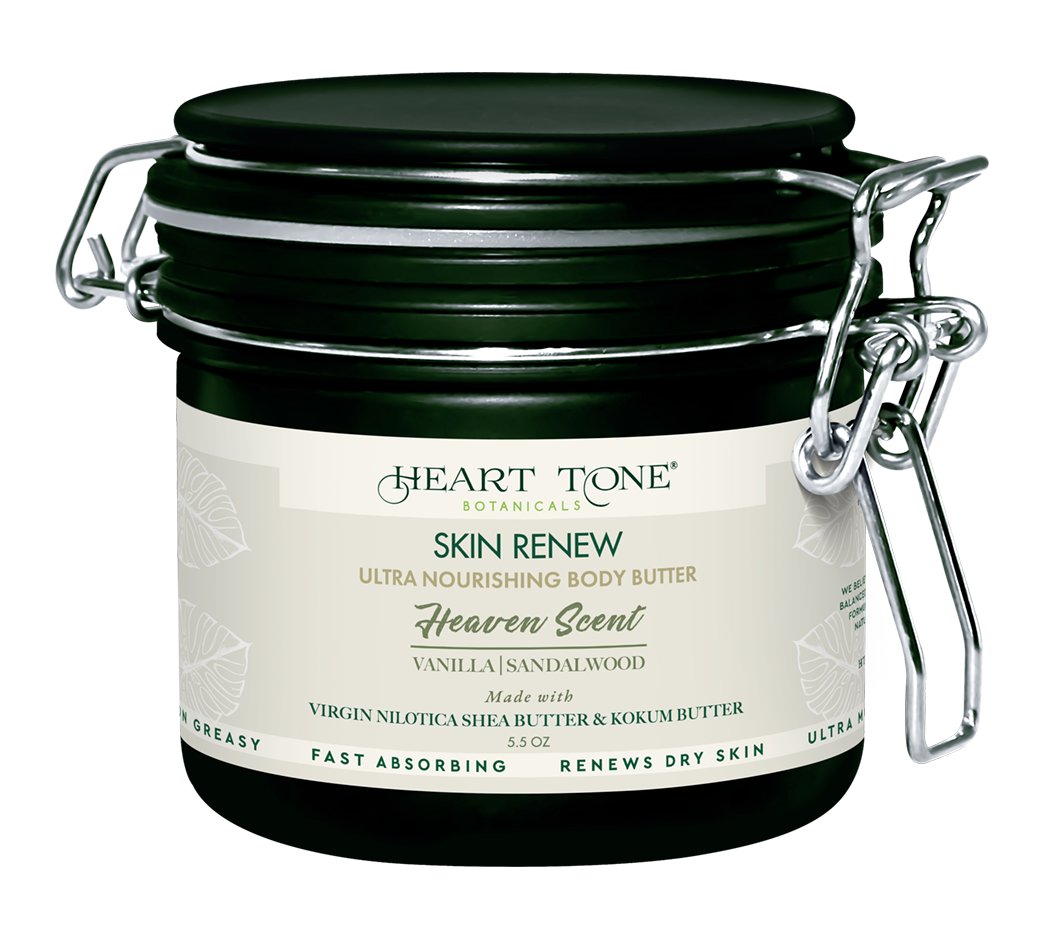
Botanical Renew Body Butter from Heart Tone Botanicals is built on Virgin Nilotica Shea Nut Butter and Kokum Butter — two plant butters with a long history in traditional botanical skincare. Meadowfoam Seed Oil rounds out the base for a silky-smooth application, and Elderberry Extract and Vitamin E are included in all three scent variants.
It comes in three botanical scent profiles:
- Heavenly Scent — Vanilla and sandalwood
- Bohemia — Lemon verbena and bergamot
- Day Dream — Lavender, neroli, and chamomile
Applied right after patting dry, a small amount goes a long way. Skin that has been stripped by a conventional body wash tends to need much more product to feel comfortable — castile soap as a first step often means less body butter is needed to achieve the same result.
For Problem Areas: A Lightweight Botanical Layer
Some spots — rough elbows, dry knees, patches that feel persistently uncomfortable — benefit from a little more attention than a full-body butter application provides. A lightweight gel formula can be applied to targeted areas and absorbs quickly, without the heaviness of a butter on the full body.
Botanical Skin Gel from Heart Tone Botanicals is built around organic aloe vera and colloidal silver — both of which have long histories in traditional topical botanical care. The formula also includes calendula, comfrey, chamomile, gotu kola, and allantoin, in a lightweight gel base that can be applied on its own or layered under the body butter on specific areas.
What Makes a Natural Dry Skin Routine Fall Short
The most common mistake isn't the moisturizer — it's starting with the wrong cleanser. A conventional sulfate-based body wash before a natural body butter puts skin through a cycle of strip-and-seal that never fully resolves the dryness. Switching the cleanser often produces a more noticeable change than adding a more expensive moisturizer on top.
A genuinely effective natural routine for dry skin:
- Starts with a cleanser that doesn't leave skin feeling tight or stripped
- Includes occasional gentle exfoliation for a smoother surface that holds moisture better
- Uses a plant-butter-based moisturizer applied while skin is still slightly damp
- Avoids synthetic fragrances, dyes, and preservatives that can cause reactions in sensitive or already-dry skin
None of this requires switching everything at once. Starting with the cleanser — replacing a sulfate-heavy body wash with a true castile soap — tends to make the most noticeable difference, fastest.
The Bottom Line
Dry skin responds well to routine changes, not just product upgrades. A botanical cleanser that doesn't strip, occasional gentle exfoliation, and a real plant-butter moisturizer applied at the right moment — it's a combination that has worked in traditional body care for a very long time, and for good reason.
If you're ready to rebuild your routine around cleaner ingredients, explore the Heart Tone Botanicals body care collection — including Botanical Renew Body Butter, Herbal Castile Liquid Soap, Moroccan Exfoliating Black Soap, and Botanical Skin Gel.

Leave a comment
This site is protected by hCaptcha and the hCaptcha Privacy Policy and Terms of Service apply.