












The Short Answer: They're Both Clays, But They Behave Very Differently in Your Mouth

If you've read an ingredient list on a natural toothpaste and seen both "kaolin clay" and "bentonite clay" — or "montmorillonite," which is the mineral name for bentonite — it's fair to wonder why a formula would need two different clays doing what looks like the same job. It isn't redundant. Kaolin and bentonite come from different geological sources, have different particle structures, and feel completely different on a toothbrush. Formulators who use both aren't hedging — they're using each one for what it actually does.
Here's what separates the two clays, why particle size matters more than the word "clay" on the label, and what to look for depending on how your mouth responds to texture.
Where Each Clay Actually Comes From
Kaolin clay is a soft, white clay formed from the weathering of aluminum silicate minerals like feldspar. It's one of the finest-textured clays used in personal care, which is why it shows up constantly in facial masks and gentle powders as well as toothpaste — the particle size is small and uniform.
Bentonite, also called montmorillonite clay, forms from weathered volcanic ash. Its particle structure is different at a mineral level: bentonite particles are plate-shaped and expand when they absorb water, giving wet bentonite a denser, more cohesive texture than kaolin. That swelling behavior is a basic property of the clay itself, not something specific to any one formula.
Texture and Feel: Where the Real Difference Shows Up
On a toothbrush, the distinction is mostly about texture rather than any single "better" clay:
- Kaolin feels finer and smoother, with a lighter, less gritty brushing sensation — a common reason it appears in formulas built for people with sensitive teeth or gums.
- Bentonite feels denser and slightly more substantial in the mouth, with a texture some people describe as more "polishing" during brushing.
- Both are considered gentle mineral abrasives compared to harder polishing agents like calcium carbonate or silica, which is part of why clay-based toothpastes tend to have a different mouthfeel than conventional ones.
Neither clay is inherently rougher or gentler in an absolute sense — the finished feel depends on particle grade, how finely the clay is milled, and what else is in the formula alongside it.
Why Some Formulas Use Both Instead of Choosing One
A toothpaste built around a single clay is making one texture decision for everyone who uses it. Combining kaolin and bentonite lets a formulator layer two particle structures — kaolin's fine, even texture alongside bentonite's denser, more substantial one — so the brushing experience isn't dependent on just one mineral's properties. It's the same logic behind blending multiple essential oils instead of relying on a single note: the combination rounds out what any one ingredient does on its own.
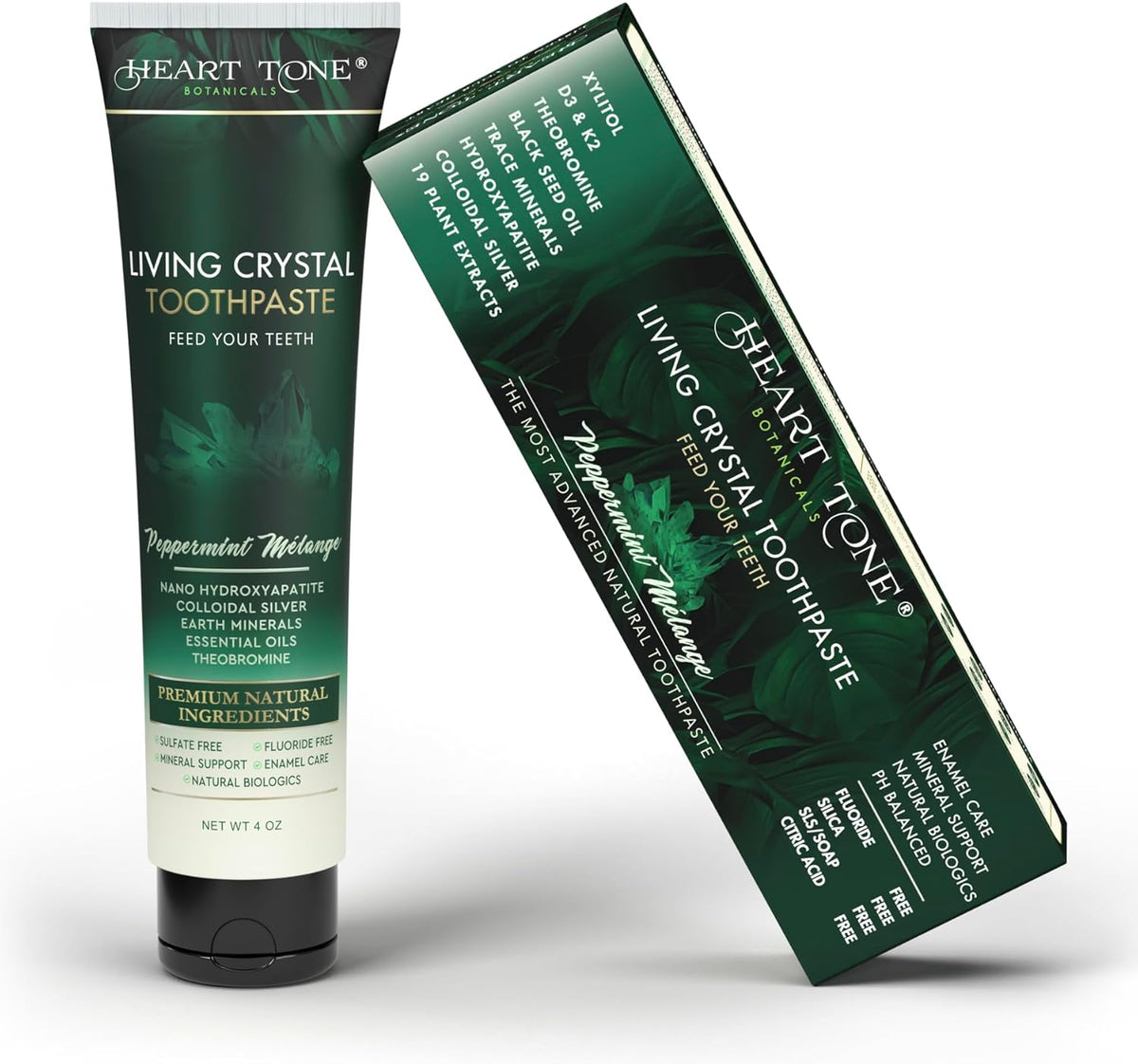
Living Crystal Toothpaste from Heart Tone Botanicals is formulated this way, with both kaolin clay and bentonite (montmorillonite) clay alongside mineral ingredients like micro-hydroxyapatite and zeolite, plus an array of farm-grown botanical extracts. The two clays sit in the base of the formula rather than being the whole story — the texture comes from the combination, not from either clay in isolation.
What This Means for the Appearance of Surface Stains
Both clays are mild polishing agents, and mild polishing is generally associated with a slower, gentler approach to the visible appearance of surface stains compared to more aggressive brightening abrasives like higher-grit silica. If a gradual, lower-abrasion approach to brightness is the goal, a clay-based formula is built around a different pace than a fast-brightening paste — not a stronger or weaker version of the same one.
What to Look For If You're Choosing Between Them
A few practical things to check on a label:
- Particle size isn't listed, but milling quality is — a well-milled clay (kaolin or bentonite) should feel smooth when dry-rubbed between your fingers, not sandy.
- Look at what surrounds the clay in the ingredient list. A short list where clay is doing most of the work behaves differently than a fuller formula where clay is one texture ingredient among several minerals and botanicals.
- If your teeth or gums are sensitive to texture, a kaolin-forward formula is generally the gentler starting point; if you prefer a denser, more substantial brushing feel, a formula that includes bentonite will read that way.
- Neither clay needs to be "activated" or heated to function in a toothpaste — that's a distinction that matters more in skincare masks than in a daily oral care formula.
The Bottom Line
Kaolin and bentonite are both mineral clays, but they aren't interchangeable — kaolin is finer and lighter, bentonite is denser and more substantial, and each brings a different texture to a toothpaste base. A formula that uses both isn't doubling up; it's balancing two particle structures instead of asking one clay to do every job.
Heart Tone's Living Crystal Toothpaste is a fluoride-free formula built around kaolin clay and bentonite (montmorillonite) clay alongside micro-hydroxyapatite, zeolite, and farm-grown botanical extracts, designed for a balanced daily brushing texture rather than a single-note one. Pair it with the Restorative Mouth Rinse, an alcohol-free botanical mouthwash, for a complete daily routine — or browse the full natural oral care collection.

Leave a comment
This site is protected by hCaptcha and the hCaptcha Privacy Policy and Terms of Service apply.