

If you've ever stood in the skincare aisle staring at a bottle labeled "toner" wondering what it actually does — you're not alone. Toner is one of the most misunderstood steps in skincare. For decades it was sold as something harsh: an astringent meant to "close pores" and strip away any trace of oil. Spoiler: that's not what your skin needs.

Here's what a facial toner actually is, what it should do, and why a plant hydrosol is the most underrated upgrade in a clean skincare routine.
What Is a Facial Toner, Really?
The original toners were essentially alcohol-based astringents — designed to remove any remaining residue after cleansing and leave skin feeling "squeaky clean." The problem? That squeaky-clean feeling is your skin's acid mantle being stripped away. The acid mantle is the slightly acidic film that protects your skin from bacteria, pollution, and moisture loss. When you strip it, your skin overproduces oil, becomes sensitized, and absorbs less of everything you put on afterward.
Modern toners — the ones worth using — work completely differently. A good toner today is a pH-balancing, hydrating prep layer that:
- Restores your skin's natural pH after cleansing
- Adds a first layer of lightweight hydration
- Preps your skin to actually absorb your serum and moisturizer
- Calms inflammation and supports your skin barrier
It's not about drying out. It's about setting your skin up to receive everything that comes next.
Toner vs. Hydrosol: What's the Difference?
Not all toners are created equal — and the ingredient list tells you everything.
Most drugstore toners are water mixed with alcohol, synthetic fragrance, and a handful of chemical preservatives. They look like skincare but they're doing very little for your skin (and often actively damaging it).
A hydrosol is something different entirely.
Hydrosols are the pure plant waters captured during steam distillation — the same process used to create essential oils. When plant material (rose petals, neroli blossoms, chamomile flowers) is distilled, the steam carries volatile compounds through a condenser. What comes out is a water-based liquid containing genuine phytochemicals from that plant. It's not diluted essential oil. It's not synthetic fragrance. It's the actual bioavailable water-soluble constituents of the plant.
That's a fundamentally different skincare ingredient — and it's what makes a hydrosol toner worth using.
What Does Toner Do in a Skincare Routine?
Here's something most people don't know: your skin's pH after cleansing is often too alkaline. Even gentle cleansers can push your skin's pH from its natural range (around 4.5–5.5) up to 7 or higher. At that elevated pH, your skin's protective enzymes work less effectively, and your barrier function is temporarily compromised.
A hydrating toner — especially one based on plant hydrosols — quickly restores your skin to its natural acidic state. That means:
- Better absorption: Serums and moisturizers absorb more effectively into skin that's been properly prepped and lightly hydrated first
- Stronger barrier: A restored pH helps your acid mantle function as it should — protecting against irritants and locking in moisture
- Calmer skin: Plant hydrosols (especially rose and chamomile) are naturally anti-inflammatory and soothing
- More hydration: Layering lightweight hydration before your serum means more moisture at every layer
If you've ever wondered why your serum isn't absorbing well or why your moisturizer sits on top of your skin instead of sinking in — skipping toner is often the culprit.
Why Most Drugstore Toners Are Doing More Harm Than Good
Let's be honest about what's in most commercial toners. Flip over a bottle and you'll typically find:
- Alcohol (ethanol or isopropyl alcohol) — immediately strips your skin's moisture barrier
- Synthetic fragrance — one of the top skin sensitizers; linked to contact dermatitis and barrier disruption
- Astringents (witch hazel with alcohol, salicylic acid at high concentrations) — can be useful in targeted doses but strip the acid mantle when used daily across the whole face
- Chemical preservatives — necessary to shelf-stabilize a water-based product, but not always skin-friendly
These toners leave skin feeling "tight" — and that tight sensation has been marketed as effectiveness. In reality, that feeling is your skin telling you its barrier has just been disrupted.
What to Look for in a Natural Facial Toner
If you want a toner that actually supports your skin rather than stripping it, here's what matters:
- Plant hydrosols as a base: Rose hydrosol, neroli hydrosol, chamomile hydrosol, lavender hydrosol — these are hydrating, pH-appropriate, and packed with natural phytochemicals
- Aloe vera: A genuinely soothing, hydrating ingredient that supports barrier function
- No alcohol: Not in the primary formula (some formulas include a trace of fatty alcohols for emulsification, which is different — avoid ethanol and isopropyl alcohol)
- No synthetic fragrance: If it just says "fragrance" on the label, pass
- Minimal ingredient list: A good hydrosol toner doesn't need 30 ingredients
The best natural toners for your face are essentially closer to the plant than they are to chemistry.

The Most Underrated Step in Clean Skincare
If you're building a clean skincare routine and you're skipping toner — this is probably the single highest-leverage addition you can make.
Here's why: most people apply a cleanser, then go straight to serum. The serum lands on skin that's slightly alkaline, stripped of surface moisture, and not optimally primed. You're paying for a premium serum and getting maybe 60% of its benefit.
Add a hydrosol toner between your cleanser and serum and you change the whole equation. Skin is pH-balanced, lightly hydrated, and ready to receive active ingredients. Your serum penetrates better. Your moisturizer binds more effectively. The whole routine performs better.
It takes 10 seconds. It's the step most people skip. It's probably the most impactful thing you're not doing.
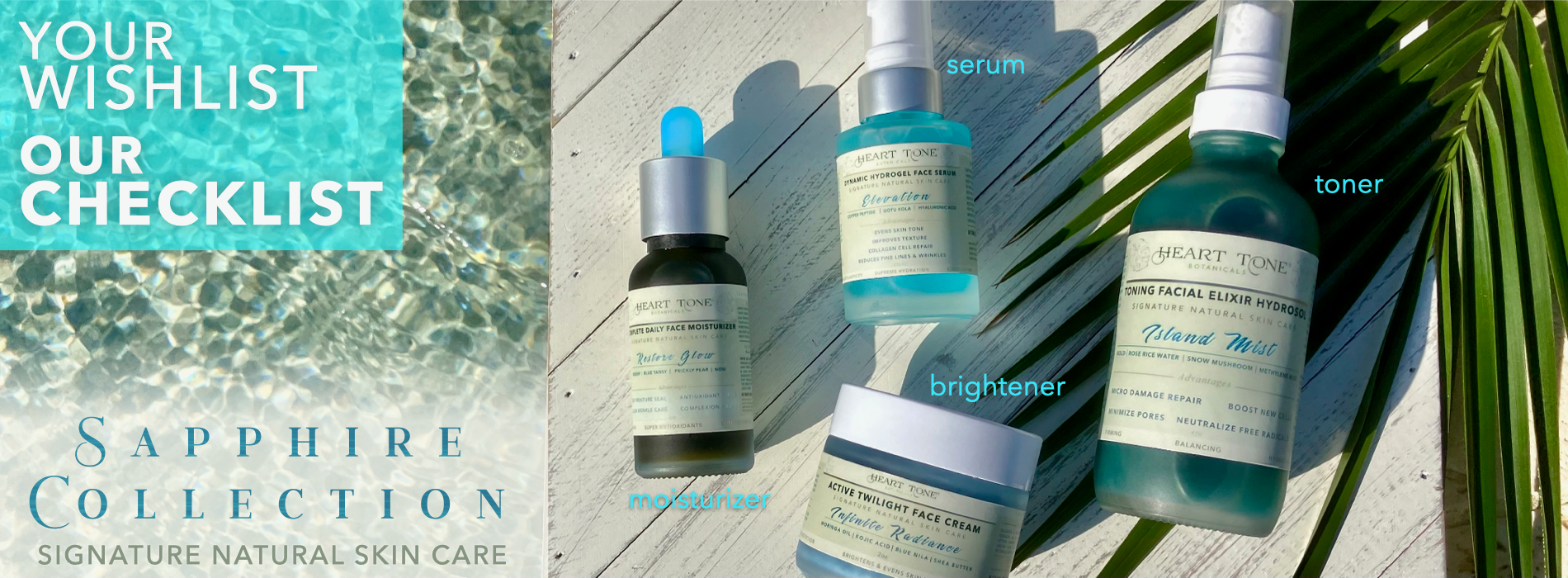
Island Mist Toning Facial Elixir Hydrosol
Heart Tone Botanicals' Island Mist Toning Facial Elixir Hydrosol is built around this exact philosophy — genuine plant hydrosol, not synthetic water.
JD's botanicals come from his farm in Vero Beach, Florida — a place where the growing conditions produce plants with exceptional phytochemical richness. That farm-sourced difference matters when you're working with steam distillation. You're not diluting a synthetic base. You're capturing actual plant chemistry in a form your skin recognizes and responds to.
Island Mist is formulated to restore, hydrate, and prep — not strip. It's the toner step that clean beauty has been missing.
Use it after cleansing, before your serum. Mist or apply with a clean cotton round, let it absorb for 30 seconds, then follow with your serum and moisturizer.
Building Your Complete Routine
For the best results, Island Mist works beautifully as part of a full facial care system:
- Toner: Island Mist Toning Facial Elixir Hydrosol — pH balance, first hydration layer, barrier prep
- Serum: Dynamic Hydrogel Face Serum — lightweight hydration and active ingredients that absorb better after toning
- Moisturizer: Complete Daily Face Moisturizer — locks in everything beneath it
That full system — cleanser, toner, serum, moisturizer — is what we call The AM/PM Face System. Each product is designed to layer with the others, so nothing is working in isolation.
Do You Actually Need a Toner?
Technically? No. You can skip it and still have functional skin.
But if you're investing in clean skincare — if you're paying attention to what goes on your face and why — then a hydrosol toner is one of the smartest additions you can make. It costs almost nothing in time, it dramatically improves the performance of everything else in your routine, and it's one of the few steps that's genuinely hard to mess up.
The question isn't really whether you need one. The question is: why wouldn't you use one?
Try Island Mist Toning Facial Elixir Hydrosol →
Browse the full facial care collection at Heart Tone Botanicals.

Leave a comment
This site is protected by hCaptcha and the hCaptcha Privacy Policy and Terms of Service apply.