

Walk into any beauty aisle — or scroll through any skincare brand's site — and you'll find shelves lined with serums. Brightening serums. Hydrating serums. Anti-aging serums. Collagen serums. The word is everywhere, but the actual meaning has been stretched so thin that most shoppers have no idea what a serum is supposed to do, let alone how to choose one that will actually work.

This post cuts through the noise. We'll explain what a serum is at a functional level, why most conventional serums are built on a synthetic foundation that undermines their own "natural" claims, what a genuinely plant-based serum looks like, and how to layer one correctly so it actually does what it's supposed to.
What Is a Face Serum, Really?
A serum is a concentrated, lightweight treatment designed to deliver active ingredients deep into the skin. That's the key distinction: concentration and penetration depth.
Compared to a moisturizer, a serum has:
- A higher concentration of active ingredients — less filler, more function
- Smaller molecular weight — the molecules are physically smaller, allowing them to pass more easily through the outer layers of skin
- Lower viscosity — thinner texture, faster absorption, less occlusion
- No heavy occlusive layer — a serum is not designed to seal moisture in; it's designed to deposit actives before your moisturizer does that job
A moisturizer works primarily on the surface and just below it — it hydrates, softens, and creates a protective barrier. A serum works deeper. It's the vehicle for getting potent ingredients — antioxidants, humectants, botanical extracts, polyphenols — where they need to go.
Because of this, the order matters: serum always goes on after cleansing and toning, and before your moisturizer. We'll come back to layering in a moment.
The Problem With Most Conventional Serums
Here's the part most brands don't want to talk about.
Many serums are marketed with a standout natural ingredient front and center — hyaluronic acid, vitamin C, niacinamide, rosehip, retinol. The ingredient sounds impressive, and it might even be genuinely effective. But the base it's dissolved in? Almost always synthetic.
Common culprits:
- Silicone bases — cyclopentasiloxane, dimethicone, and similar compounds create that silky, "glides on skin" feeling. They're not harmful exactly, but they're not natural, they don't absorb into skin (they sit on top), and they can interfere with your skin's ability to breathe and function
- PEGs (polyethylene glycols) — used as penetration enhancers and emulsifiers, PEGs are petroleum-derived and can carry contaminants like ethylene oxide and 1,4-dioxane. They do help actives penetrate deeper — but at a cost
- Synthetic preservatives — parabens, phenoxyethanol, MIT (methylisothiazolinone) — used to extend shelf life, some linked to skin sensitization or endocrine disruption
- Synthetic peptides in artificial matrices — lab-engineered peptides suspended in silicone or glycol bases; the peptide may be functional, but the vehicle is wholly industrial
This is what we call the "active ingredient in a synthetic base" problem. The hero ingredient gets the headline. The carrier matrix — which makes up the majority of the formula by volume — gets buried in the ingredient list. A serum can be 5% vitamin C and 95% synthetic silicone and still be marketed as a "natural" vitamin C serum.
If you're choosing a serum because you want to support your skin with clean, plant-derived nutrition — and keep synthetics off your face — the base matters just as much as the active.
What Genuinely Natural Serums Are Made Of
A truly natural serum uses plant-sourced ingredients all the way down — not just in the headline actives, but in the base, the preservative system, and the penetration-support ingredients.
Here's what to look for:
Hydrosols as a Base
Plant hydrosols — rose water, lavender hydrosol, chamomile water — are the byproduct of steam distillation of botanicals. They're light, water-based, carry active aromatic compounds, and are far more functional than plain distilled water. A hydrosol base means your serum is doing something from the very first ingredient listed.
Botanical Humectants (Natural Hyaluronic Acid Alternatives)
Hyaluronic acid has become synonymous with hydration — but most HA in skincare is synthetically fermented or animal-derived. Plant-based alternatives include:
- Aloe vera — acemannan, the polysaccharide in aloe, is a natural humectant and skin-soothing agent with well-studied anti-inflammatory properties
- Marshmallow root extract — rich in mucilaginous polysaccharides that mimic the water-binding action of HA
- Tremella mushroom extract — sometimes called "nature's hyaluronic acid," with smaller molecules and higher water retention than conventional HA
- Prickly pear cactus — extraordinarily rich in betalains and antioxidants, with natural humectant behavior
Plant Polyphenols and Herbal Extracts
Polyphenols from plants — green tea, pomegranate, turmeric, rosemary — are potent antioxidants that protect against oxidative stress and support collagen integrity. In a clean serum, these aren't just marketing additions; they're functional actives that work at a cellular level.

Cold-Pressed Plant Oils (in low concentrations)
Light botanical oils — sea buckthorn, rosehip, meadowfoam seed — can deliver essential fatty acids and fat-soluble antioxidants (vitamin E, vitamin A precursors) without the heaviness of conventional oils, especially when used in small concentrations in a serum matrix.
Plant-Derived Preservation
Rosemary antioxidant, vitamin E (tocopherol), and systems built around naturally antimicrobial botanicals can preserve formulas without parabens or synthetic biocides.
How to Read a Serum Label
Ingredients are listed in descending order by concentration. Here's what to watch for specifically on a serum:
- What's #1? If it's "Aqua" or "Water" with nothing else in the top 5, that's a thin, water-based formula with little natural depth. If it's a hydrosol or aloe vera juice, that's a better sign.
- Look for silicones in the top 10 — cyclopentasiloxane, dimethicone, cyclohexasiloxane. Even one means it's a silicone-based serum, regardless of what else is in it.
- Check the preservatives — phenoxyethanol, methylparaben, propylparaben, MIT, DMDM hydantoin. Any of these signals a synthetic preservation system.
- PEG compounds — any ingredient with "PEG-" in the name is a polyethylene glycol derivative.
- Where do the "natural" ingredients actually appear? If rosehip and turmeric appear in positions 18-22 on a 22-ingredient list, they're present at trace levels — likely under 0.1%. They're decoration, not function.
A genuinely clean serum should have recognizable plant-derived ingredients in the first half of the list, with synthetics either absent entirely or minimal and non-occlusive.
How to Layer a Serum Correctly
The order you apply products matters because skin is selective about what it lets in, and each layer creates a slightly different surface condition.
The correct sequence:
- Cleanser — remove surface debris, excess oil, and anything that would block penetration
- Toner or hydrosol — rebalance pH (skin is naturally slightly acidic), provide a first layer of hydration, and prime the surface for better serum absorption. Damp skin absorbs actives more effectively than dry skin.
- Serum — apply to damp skin, press in gently, let absorb for 60–90 seconds before the next step. Don't rub hard — patting and light pressing is more effective.
- Moisturizer — seals in the serum and provides barrier support. This is where your Complete Daily Face Moisturizer does its job: locking in what the serum deposited while providing its own skin-nourishing ingredients.
- SPF (morning only) — always the final step in an AM routine.
A common mistake: applying serum to completely dry skin right after cleansing, then immediately layering moisturizer. This gives the serum no time to absorb and no moisture surface to work with. Damp skin + 60-second wait = meaningfully better results.
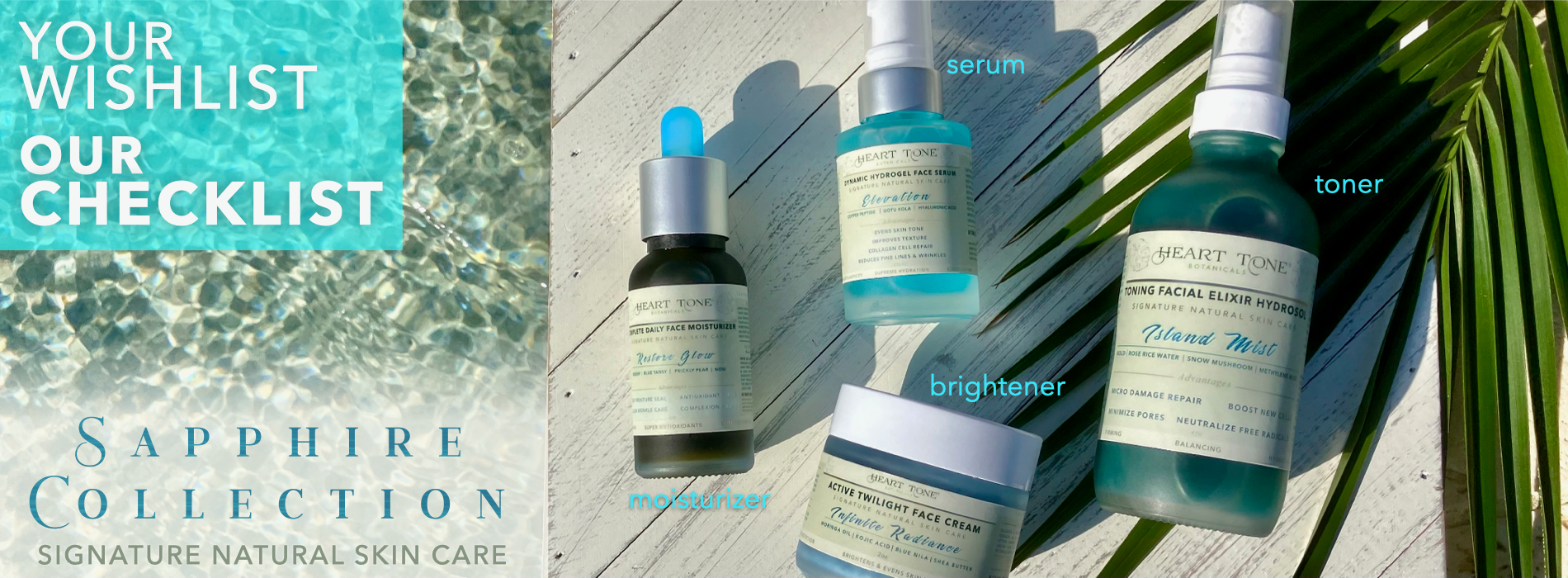
What Makes HTB's Dynamic Hydrogel Face Serum Different
Most serums that call themselves "natural" are conventional formulas with a few plant extracts added in. The base is synthetic. The preservative is synthetic. The penetration enhancers are synthetic. A rosehip extract at 0.5% concentration does not make a serum "plant-based."
The Dynamic Hydrogel Face Serum was built from the opposite direction: start with a plant-sourced hydrogel base, then build the active system on top of it with beyond-organic botanicals.
What that means in practice:
- Hydrogel from plant sources — the base itself is botanical, not silicone or synthetic polymer. This changes the delivery mechanism entirely — you're not getting a silicone film; you're getting a living plant matrix
- Farm-grown botanicals — not extracted from commodity supply chains, not standardized to the lowest-acceptable-grade. HTB sources and uses beyond-organic ingredients, meaning grown without synthetic pesticides or herbicides and harvested with quality as the priority
- Concentrated actives in a clean vehicle — the serum is doing what serums are supposed to do, without the synthetic scaffolding that most brands rely on
- Formulated for sensitive skin — no synthetic fragrances, no parabens, no PEGs. If your skin has reacted to serums before, the culprit was almost certainly a synthetic ingredient in the base, not the botanicals themselves
If you want a complete morning and evening routine built around clean, plant-based skincare, the AM/PM Face System pairs the Dynamic Hydrogel Face Serum with the Full Spectrum Botanical Cleanser and Complete Daily Face Moisturizer — everything you need, in the right layering order, without a single synthetic shortcut.
The Bottom Line
A serum is one of the most important steps in your skincare routine — and one of the easiest places for synthetic ingredients to hide in plain sight. The active ingredient gets the marketing. The base gets ignored. But the base is where most of the formula lives.
A genuinely natural serum uses plant hydrosols, botanical humectants, herbal polyphenols, and clean preservation — all the way through, not just in the ingredients that get named on the front of the bottle.
If you're ready to trade in the synthetic base for something that's actually plant-built, the Dynamic Hydrogel Face Serum is where to start.
Questions about layering, ingredients, or whether HTB's serum is right for your skin type? Reach out — we're a small farm-to-face brand and we actually answer.

Leave a comment
This site is protected by hCaptcha and the hCaptcha Privacy Policy and Terms of Service apply.