

Pick up almost any bar of soap at a drugstore and read the back label. You'll see words like "beauty bar," "moisturizing bar," or "cleansing bar." Not soap. There's a reason for that — and it matters more than most people realize.

The FDA has a strict legal definition of soap. For a product to be called soap, it must be made from oils or fats reacting with an alkali — the ancient process of saponification that humans have used for thousands of years. Many commercial bars don't meet that definition. So they can't legally be called soap. Instead, they're classified as synthetic detergent bars.
And detergent is exactly what they are.
What's Actually in That Bar You're Lathering All Over Your Body
Walk through the ingredient list of a typical drugstore "beauty bar" and you'll find a cocktail that has almost nothing to do with cleaning your skin and a lot to do with cutting manufacturing costs:
Sodium Lauryl Sulfate (SLS) / Sodium Laureth Sulfate (SLES)
These are the synthetic surfactants that create the rich foam most people associate with a "good" clean. The problem: research published in toxicology journals shows that SLS disrupts cell membranes and proteins in the outer skin layer — even at concentrations as low as 0.9–1%. The result is increased transepidermal water loss, a thinning of the skin's natural barrier, dryness, and over time, chronic irritation. Dermatologists routinely recommend SLS-free products to patients with eczema, rosacea, psoriasis, and sensitive skin. You're lathering this onto your skin twice a day.
Synthetic Fragrance
The word "fragrance" on a label is legally allowed to conceal hundreds of individual chemicals — including phthalates, a class of compounds the research community has linked to endocrine disruption, reproductive toxicity, and hormonal interference. Phthalates don't just sit on the surface — they're absorbed through the skin. A landmark study found that switching away from fragranced personal care products measurably reduced phthalate metabolites in urine within three days. Three days. That's how fast these chemicals clear when you stop using them — and by extension, how fast they're building up when you do.
The fragrance industry is allowed to keep its formulas as trade secrets. "Fragrance" on your soap label could be a blend of 50, 100, or more synthetic chemicals. You'll never know which ones.
Parabens and Preservatives
Methylparaben, propylparaben, butylparaben — these synthetic preservatives extend shelf life and show up in product after product. Parabens are recognized endocrine-active compounds; they can mimic estrogen in the body. They've been detected in breast tissue samples in studies going back decades. Regulatory bodies debate what level is "safe." The problem is cumulative exposure: soap, shampoo, conditioner, lotion, deodorant — parabens in every product, every day, for years.
The Glycerin Theft
Here's the part that almost nobody talks about: real soap, made the traditional way, produces glycerin as a natural by-product of saponification. Glycerin is a humectant — it draws moisture to the skin, keeps it soft, and protects the barrier. In commercial manufacturing, that glycerin is extracted and sold separately, often to the cosmetics industry for use in lotions and creams. What's left is a stripped, harshened bar. So the very ingredient that would make your skin feel good after washing gets pulled out and sold back to you in a separate moisturizer. Twice the product. Half the bar.
What Cold-Process Soap Actually Is
Cold-process soap is the real thing. Oils and fats — in our case, organic vegetable oils including coconut, hemp, and olive — are combined with sodium hydroxide (lye) and allowed to saponify slowly at low temperature. The lye is fully consumed in the reaction. What remains is pure soap: fatty acid salts that clean gently and effectively, and the full complement of natural glycerin left exactly where it belongs — in the bar.
No synthetic detergents. No foaming agents manufactured in a refinery. No petroleum derivatives. Just oils, water, and chemistry that has existed for millennia.

The scent? Essential oils — actual plant extracts with known compounds and no hidden phthalate load. Peppermint, lavender, citrus, clove — real botanical sources, not a fragrance lab formulation.
The "Forever Chemical" Problem in Personal Care
PFAS — per- and polyfluoroalkyl substances, often called forever chemicals — don't biodegrade. They accumulate in the body and in the environment. Independent testing has detected PFAS in a range of cosmetics and personal care products, including some foundations, mascaras, and skin creams. The personal care industry has been slow to address this. If your products don't explicitly test for and exclude PFAS, you have no guarantee they're not present.
When every ingredient in a soap is a named plant oil or essential oil, the PFAS conversation becomes simple: they're not there. There's nowhere to hide.
What to Look For on the Label
If you're evaluating a bar soap, the ingredient list tells you everything:
- Real soap: You'll see named oils (saponified coconut oil, saponified olive oil, etc.) or sodium hydroxide listed with the oils used. Glycerin may appear as a retained by-product.
- Detergent bar: You'll see sodium lauryl sulfate, sodium laureth sulfate, sodium cocoyl isethionate, or similar synthetic surfactants at the top of the list.
- Red flags: "Fragrance" or "parfum" without clarification, any paraben (-paraben suffix), PEG compounds, BHT, DMDM hydantoin, formaldehyde-releasing preservatives.
If you see "beauty bar" or "cleansing bar" instead of "soap" on the front of the package — that's not an accident. That's the manufacturer telling you what their lawyers already know.
Our Soaps Are Built Differently
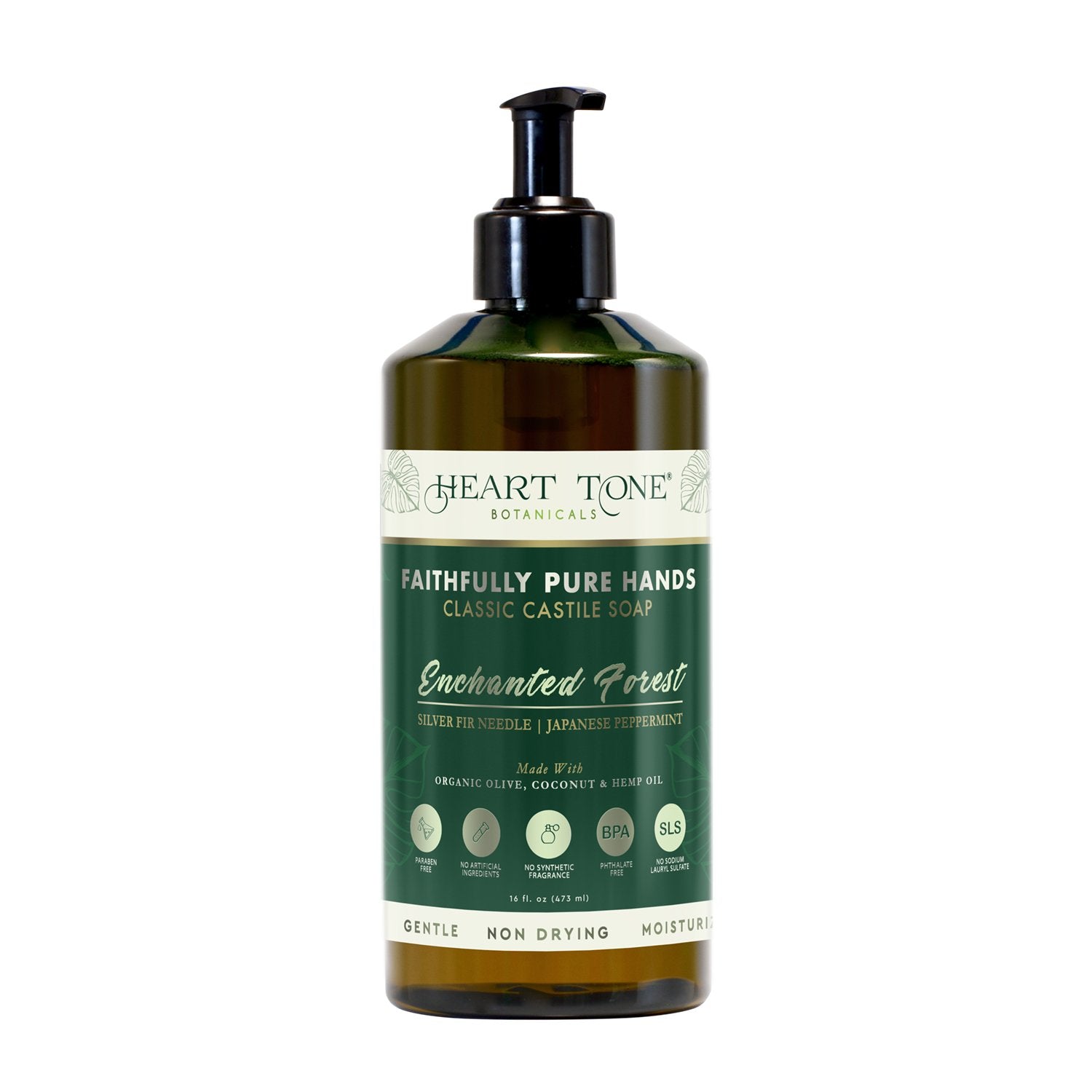
Heart Tone Botanicals' Ancient Organic Soaps are cold-processed from organic vegetable oils on our biodynamic farm in Vero Beach, Florida. Every bar is made by hand, scented with real essential oils, and never stripped of its natural glycerin. There are no synthetic detergents, no synthetic fragrances, no parabens, no forever chemicals, and no trade-secret ingredient blends hiding behind a single word on the label.
You can read every ingredient we use and know exactly what it is. That's not a marketing promise — it's just the nature of making soap the right way.
Your skin absorbs what you put on it. Make it count.
Ancient Organic Soaps — cold-processed, farm-made, nothing hidden.
SHOP ANCIENT ORGANIC SOAPS

Leave a comment
This site is protected by hCaptcha and the hCaptcha Privacy Policy and Terms of Service apply.