












If you have ever flipped over a conditioner bottle and seen dimethicone, cyclomethicone, or cyclopentasiloxane on the label, you have been using silicones. For many people, that is fine. But a growing number of hair care shoppers prefer to skip them — and if you are in that group, the first question is not which conditioner to buy. It is: what will replace the silicone, and will the formula actually work for my hair?
This guide walks through what silicones do in conventional formulas, what plant-based conditioners use instead, and what to look for when you read the label.
What Silicones Do in Conventional Conditioners

Silicones are synthetic polymers derived from silicon and oxygen. In hair care, they work as film-forming agents: they coat the outside of the hair shaft, creating a smooth, glossy surface that is easy to detangle. The result is hair that looks and feels smooth right after washing.
The trade-off is that most silicones are not water-soluble. Over time, they can accumulate on the hair, building up layer after layer of coating. For some hair types — particularly low-porosity, fine, or straight hair — that buildup can leave hair feeling heavy, limp, or difficult to moisturize. For curlier or coarser hair, many people find that silicone buildup eventually makes hair feel dry underneath the coating, even if it looks shiny on the surface.
Silicone buildup typically requires a sulfate-based shampoo to remove — which creates its own cycle if you are also trying to avoid harsh cleansers.
What Silicone-Free Conditioners Use Instead
A silicone-free conditioner has to deliver slip, softness, and some degree of detangling through other means. That is where botanical ingredients come in.
Plant-derived fatty alcohols — like cetyl alcohol and brassica alcohol — are among the most common silicone alternatives. Despite the name, these are nothing like the drying alcohols in some toners or astringents. They are solid at room temperature, derived from plant fats, and they melt into the hair to provide slip and softness. Cetyl alcohol has a long history of use in hair and skin care formulations. Brassica alcohol, derived from plant sources, has a similar feel and is widely used in modern natural formulas.
Plant butters and oils contribute a different kind of conditioning. Shea butter, coconut milk, and similar ingredients have been used in hair care across many traditions for centuries. They leave hair feeling soft and manageable without the film-forming behavior of silicones.
Botanical leaf extracts like papaya leaf, moringa leaf, guava leaf, aloe vera, and Irish moss each bring their own texture and sensory qualities to a formula. Aloe vera has been used in traditional hair and skin care in tropical regions for generations, prized for the soft, hydrated feel it leaves behind. Irish moss has a long history as a natural thickening and conditioning ingredient. Chamomile has been used in European botanical hair care traditions for a very long time.
Fermented ingredients — like radish root ferment, lactobacillus ferment, and bamboo ferment — appear in modern botanical formulas as plant-derived alternatives to synthetic preservatives and texture agents. These fit neatly into silicone-free, paraben-free formulations.
Amino acids like L-arginine are another ingredient to look for. L-arginine is a naturally occurring amino acid that contributes to a smooth feel after conditioning, and it appears in both botanical hair care products and in many natural hair care routines.
Reading a Silicone-Free Conditioner Label
To confirm a conditioner is silicone-free, look for the absence of any ingredient ending in -cone, -conol, or -siloxane. Common ones to watch for:
- Dimethicone (the most common)
- Cyclomethicone
- Cyclopentasiloxane (often listed as D5)
- Amodimethicone
- Bis-aminopropyl dimethicone
None of these should appear on the label of a true silicone-free conditioner.
What Else to Look For
Beyond silicone-free, many people shopping this category are also interested in:
- No parabens (methylparaben, propylparaben, butylparaben)
- No synthetic fragrance — this appears on some labels as just "fragrance" or "parfum," which can mean a blend of many undisclosed ingredients
- No sulfates in the paired shampoo, so the cleansing step does not undo the conditioning work
- Plant-derived conditioning agents in place of synthetic quaternary ammonium compounds
The Roots & Locks Moisturizing Revival Conditioner
The Roots & Locks Moisturizing Revival Conditioner from Heart Tone Botanicals is formulated without silicones, parabens, or synthetic fragrance.
The formula is built on plant-based conditioning agents — brassicyl valinate esylate and brassica alcohol (both plant-derived), cetyl alcohol, and organic shea nut butter — alongside a botanical leaf extract blend featuring papaya, moringa, neem, guava, bay leaf, and aloe leaf juice extract. The formula also includes coconut milk, Irish moss extract, chamomile extract, pea peptide, bamboo ferment, daikon seed extract, and radish root and lactobacillus ferments.
Scent comes from essential oils and CO2 extracts: lavender tea tree, clary sage, cardamom CO2, myrtle, vetiver, rosemary CO2, clove CO2, and thyme CO2.
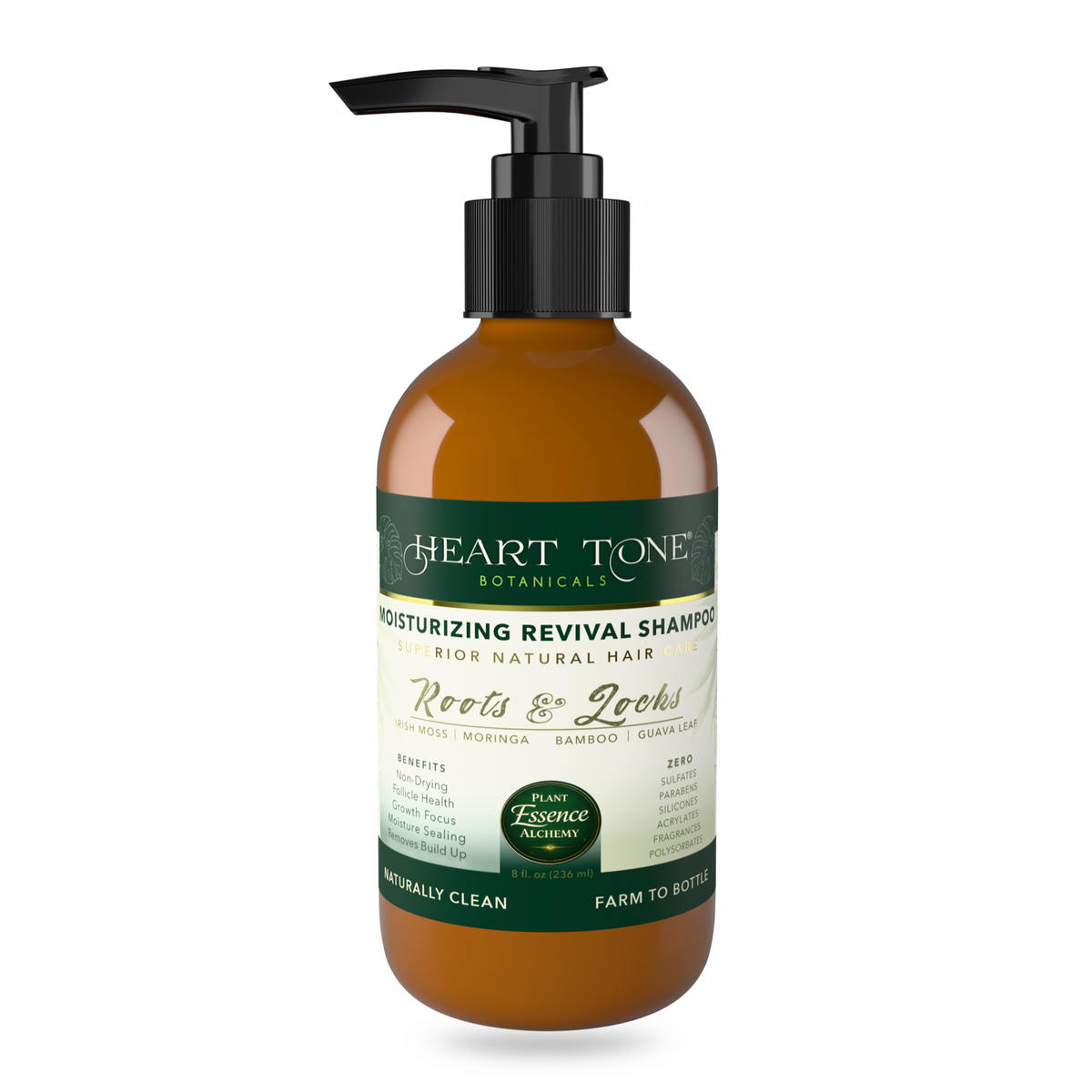
It is designed to pair with the Roots & Locks Moisturizing Revival Shampoo, which is also silicone-free and uses coco taurate — a mild coconut-derived surfactant — instead of sulfate-based cleansers.
Both are available in the Hair Care collection.
Making the Transition
If you are moving away from a silicone-heavy conditioner, your hair may go through a short adjustment period while residual buildup clears. Some people describe a week or two where their hair feels slightly different — not worse, just different — as it adjusts to conditioning without the silicone coating.
A gentle clarifying wash before your first silicone-free conditioning session can help clear the path. After that, apply conditioner from mid-length to ends, let it sit for a few minutes, and rinse thoroughly. For high-porosity or very dry hair, leaving a small amount in as a leave-in is another approach many people prefer.
Finding What Works for Your Hair
Silicone-free conditioners are not a one-size-fits-all answer. They work well for many hair types — especially high-porosity, curly, coily, and low-porosity hair that tends to accumulate coating buildup over time. But the right formula for your hair depends on your porosity, texture, and how your hair responds to different conditioning agents.
The key is reading the label carefully: knowing what silicones are, what replaces them, and what else the formula does and does not contain. That information is always on the bottle — you just have to know what you are looking for.
Browse the full Hair Care collection to explore the complete Roots & Locks line.

Leave a comment
This site is protected by hCaptcha and the hCaptcha Privacy Policy and Terms of Service apply.