












The Short Answer: It Depends on How Dry Your Skin Actually Is

Walk down any skincare aisle and you'll see both — rows of body lotion in pump bottles, and jars of thick, whipped body butter next to them. They're often priced the same, marketed the same way, and used for the same basic reason: dry skin. But they are not interchangeable. Lotion and body butter are built on different ratios of water to oil, and that ratio is the whole story.
If your skin feels tight, flaky, or rough by midday no matter how much lotion you apply, the problem usually isn't how often you're moisturizing. It's the formula.
Why Lotion Disappears So Fast
Most body lotions are formulated to be mostly water, thickened and stabilized with a smaller percentage of oils and emollients. That's exactly why lotion feels so pleasant going on — it's light, it absorbs almost instantly, and it doesn't leave a greasy film. For normal skin in a humid climate, that's often enough.
The tradeoff is that water evaporates. Once the water content of a lotion evaporates off the skin, whatever thin layer of oil was riding along with it goes too. That's why lotion can feel like it "disappears" within an hour or two, especially on hands, elbows, and shins — the driest, most exposed parts of the body.
What a Body Butter Formula Is Actually Doing Differently
Body butter flips the ratio. Instead of leading with water, a true body butter is built almost entirely from solid and semi-solid plant butters and oils — ingredients like shea butter, kokum butter, and seed oils that are solid or semi-solid at room temperature and only soften on contact with skin.
Because there's little to no water to evaporate, a well-formulated body butter forms a richer surface layer that sits on the skin longer. That layer helps slow the rate at which the skin's own moisture evaporates into the air — which is the actual mechanism behind "locking in" hydration. It's not adding water to the skin; it's helping the skin hold onto the water it already has.
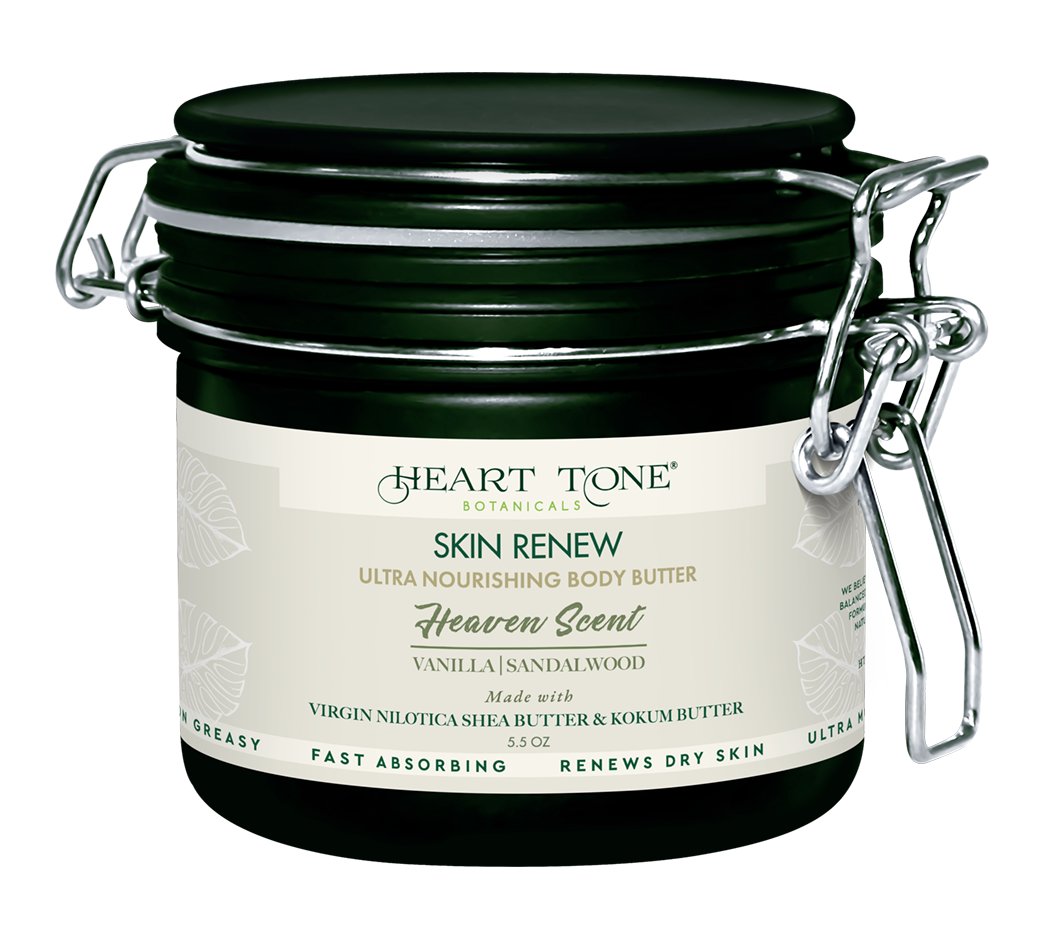
Heart Tone's Botanical Renew Body Butter is built this way. The base is virgin Nilotica shea nut butter and kokum butter, blended with meadowfoam seed oil and farm-grown elderberry extract, with organic arrowroot powder worked in to soften the texture so it feels rich without sitting heavy or greasy on the skin.
Body Butter vs. Lotion: A Practical Comparison
- Water content — Lotion is mostly water; body butter is mostly plant butters and oils, with little to no added water
- How it feels going on — Lotion absorbs almost instantly and feels light; body butter takes a moment to melt in and leaves a richer, more cushioned feel
- How long it lasts on skin — Lotion tends to need reapplication through the day; a butter's thicker layer stays on the skin longer
- Best fit for climate — Lotion works well in humid or warm conditions; body butter earns its keep in dry air, winter months, and air-conditioned spaces
- Best fit for skin type — Normal to combination skin often does fine with lotion alone; rough, flaky, or persistently dry patches respond better to a butter-based formula
Where Each One Actually Makes Sense
This isn't really an argument for one over the other — it's about matching the formula to the job. A lightweight lotion applied right after a shower can be exactly right for daily upkeep on skin that isn't especially dry. But for elbows, knees, heels, and any patch of skin that stays rough no matter what you put on it, a genuine body butter is doing more physical work per application.
Some people use both: a lotion for quick daily coverage and a body butter layered on top of the driest areas, or used at night when there's no rush to get dressed and no concern about a few extra minutes of absorption time.
How to Tell If a "Butter" Is Actually a Butter
Not every product labeled "body butter" is formulated the way the name implies. Some are lotions with a thicker texture and a butter-inspired name, still built on a mostly-water base. A few things to check on the label:
- What's listed first — if water or aqua is the first or second ingredient, it's functioning more like a lotion than a butter
- The texture at room temperature — a real butter formula should feel dense and take a moment to soften into the skin, not spread instantly like a thin cream
- What the butters actually are — shea, kokum, cocoa, and mango butter are true plant butters; "moisturizing complex" on a label doesn't tell you anything specific
The Bottom Line
Body lotion and body butter aren't competing for the same job. Lotion is a light, fast-absorbing layer that works well for skin that isn't fighting dryness. Body butter is a denser, oil-forward formula built to sit on the skin longer and help slow moisture loss on the areas that need it most.
If flaky elbows and rough patches keep coming back no matter how often you moisturize, the fix usually isn't more lotion — it's switching the formula. Botanical Renew Body Butter is built on virgin shea and kokum butters with farm-grown botanicals, made without synthetic fillers. For a lighter, everyday layer that pairs well with it, our full body care collection includes castile soaps and botanical skin gel to round out a simple, natural routine.

Leave a comment
This site is protected by hCaptcha and the hCaptcha Privacy Policy and Terms of Service apply.